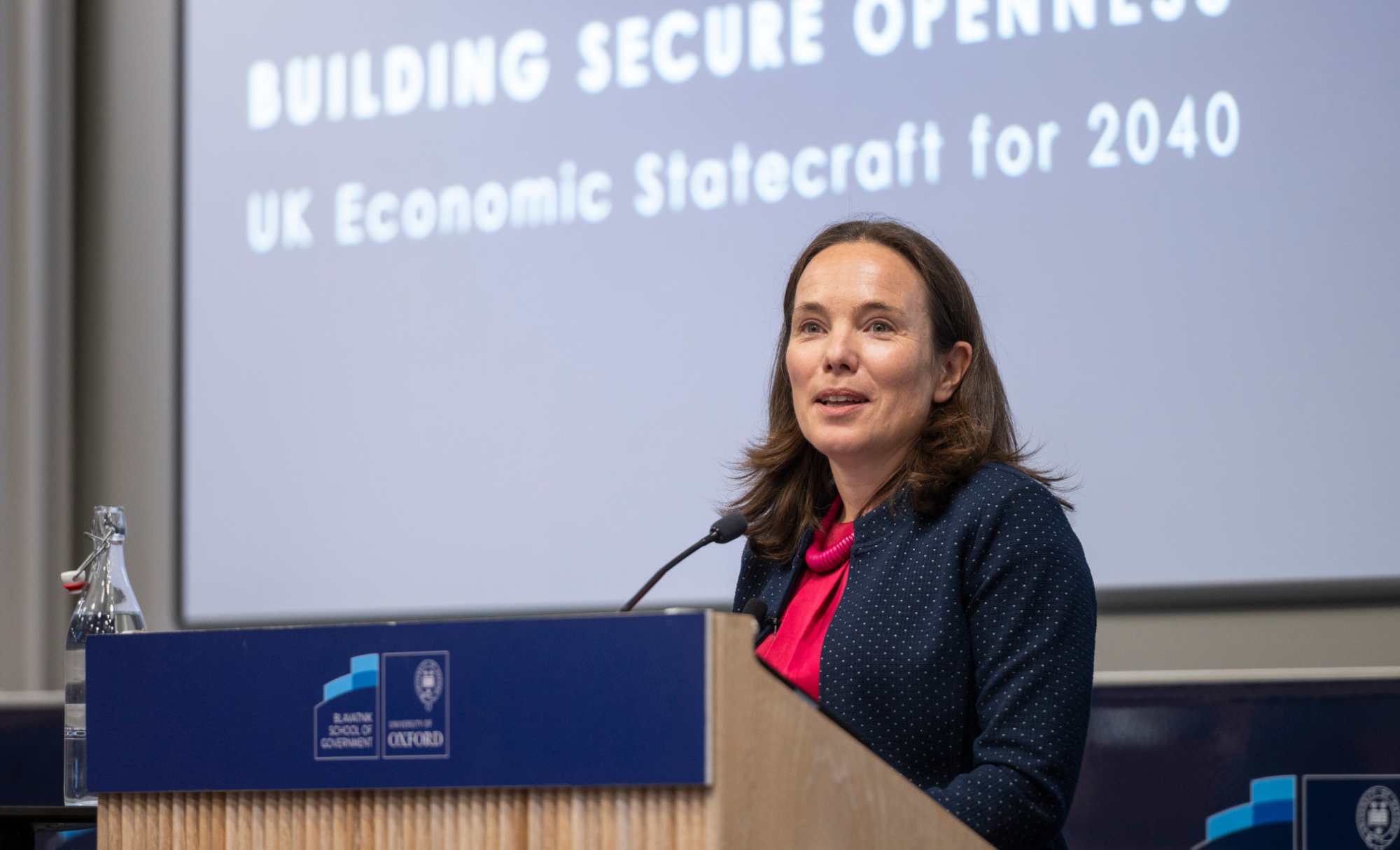
2026 Heywood Fellow Jenny Bates argues that the United Kingdom needs a new international economic strategy, one that reflects the UK's place in a changing world – balancing openness with economic security, resilience and the ability to act in the national interest.
Jenny argues that after years of economic shocks, tariffs and growing international contestation, the global economic environment has changed. Countries are making greater use of economic levers to pursue their national interests, creating new risks as well as opportunities for the UK.
Her proposed strategy is grounded in an analysis of the UK’s position in the global economy, describing the UK as a ‘pivotal middle power’. Jenny argues that while the UK has relatively less economic power than before, it remains capable of significant influence.
The strategy also reflects the economy the UK has today, with particular strengths including world-class financial services, creative industries and life sciences. But these strengths also bring vulnerabilities, including greater exposure to the closure of markets and the use of economic relationships as tools of pressure.
Research conducted by the Fellowship suggests there is public support for this direction. British people want an approach rooted in the UK national interest, with greater emphasis on resilience and security and partnerships with a wider range of countries. Read more about the research here.
Building Secure Openness
Jenny's paper, ‘Building Secure Openness: A New Economic Statecraft for 2040’, proposes a strategy focused on:
Building a more resilient economy, better able to respond to shocks and economic coercion.
More actively attracting and anchoring talent, businesses and investment in the UK.
Deepening and diversifying trusted international partnerships in technology, energy and trade
Making more strategic use of the UK's strengths to deepen partnerships and create greater economic value.
To put this strategy into practice, Jenny argues that the UK needs to:
Operate with a middle-power mindset – recognising where it can have most influence and working strategically with other countries. This is explored further in the Fellowship's ‘Middle Power Playbook’.
Reshape the relationship between business and government – building greater alignment around national objectives and a stronger focus on ensuring businesses, investment, jobs and profits stay and grow in the UK. This includes a proposed new working group between business and government, the ‘UK Global Strategic Industries Group’, as detailed in 'Bridging the gap between government and the boardroom’.
Integrate security and economics across government – building the structures, teams and expertise needed to pursue economic and security objectives together.
Jenny argues that the UK is already starting down this road, but that policy is not yet at the scale needed. The challenge now is to turn this into a long-term strategic shift – one that builds on the UK's strengths, strengthens its resilience and enables a pivotal middle power to use its influence more effectively.
Jenny Bates said:
“‘Building Secure Openness’ is not about turning away from the global economy, but about developing a form of openness that makes the UK stronger and more resilient in a more contested world.”
Business organisations have also responded to the work. Rain Newton-Smith, CEO of the Confederation of British Industry (CBI), described the paper as “insightful and thought-provoking”, highlighting the value of structured engagement between business and government in navigating strategic challenges. Steven Lynch MBE, Director at the British Chambers of Commerce, called it “critical and timely”, emphasising the need to turn UK strengths into greater market share and improve how government and business work together. Emma Bennett, Interim Secretary General at International Chamber of Commerce (ICC) UK, described it as a “timely and important contribution”, highlighting the role of government-business partnership in strengthening resilience, competitiveness and long-term growth.
Suzanne Heywood, Chair of the Heywood Foundation said:
"The Heywood Foundation is pleased to see the publication of Jenny’s work on Britain’s place in the global economic order, and to have supported her in exploring how we can adapt our approach to an ever-changing world. Jenny’s work is an important contribution to the debate, not only examining what we can learn from our past, but how we can ensure a resilient and effective strategy for the long term."
Professor Ngaire Woods, Dean of the Blavatnik School of Government, said:
“The Heywood Fellowship creates the space for senior public servants to examine complex, long-term challenges beyond the immediate pressures of government. Jenny’s work focuses on an increasingly important issue for the UK: how changes in the global economy are reshaping the context in which economic policy is made. Her work makes a valuable contribution to the discussion about how the UK understands and responds to these changes.”
Read the full ‘Building Secure Openness’ paper here.
Heywood Fellowship papers
The full suite of Heywood Fellowship papers is listed below:
Building Secure Openness: A New Economic Statecraft for 2040
Building Secure Openness: An initial agenda for action: 12 Pioneer Projects
The UK’s Role as a Pivotal Power: Middle power mindset and playbook
How the British Public Wants us to Navigate a More Uncertain Global Economy
The purpose of the Heywood Fellowship, created by the Heywood Foundation in memory of Jeremy Heywood, Cabinet Secretary from 2012 to 2018, is to give a senior UK civil servant the opportunity to explore issues relating to public service and policy outside of the immediate responsibilities of government duties, with a focus on longer-term issues and/or those that cut across government departments.