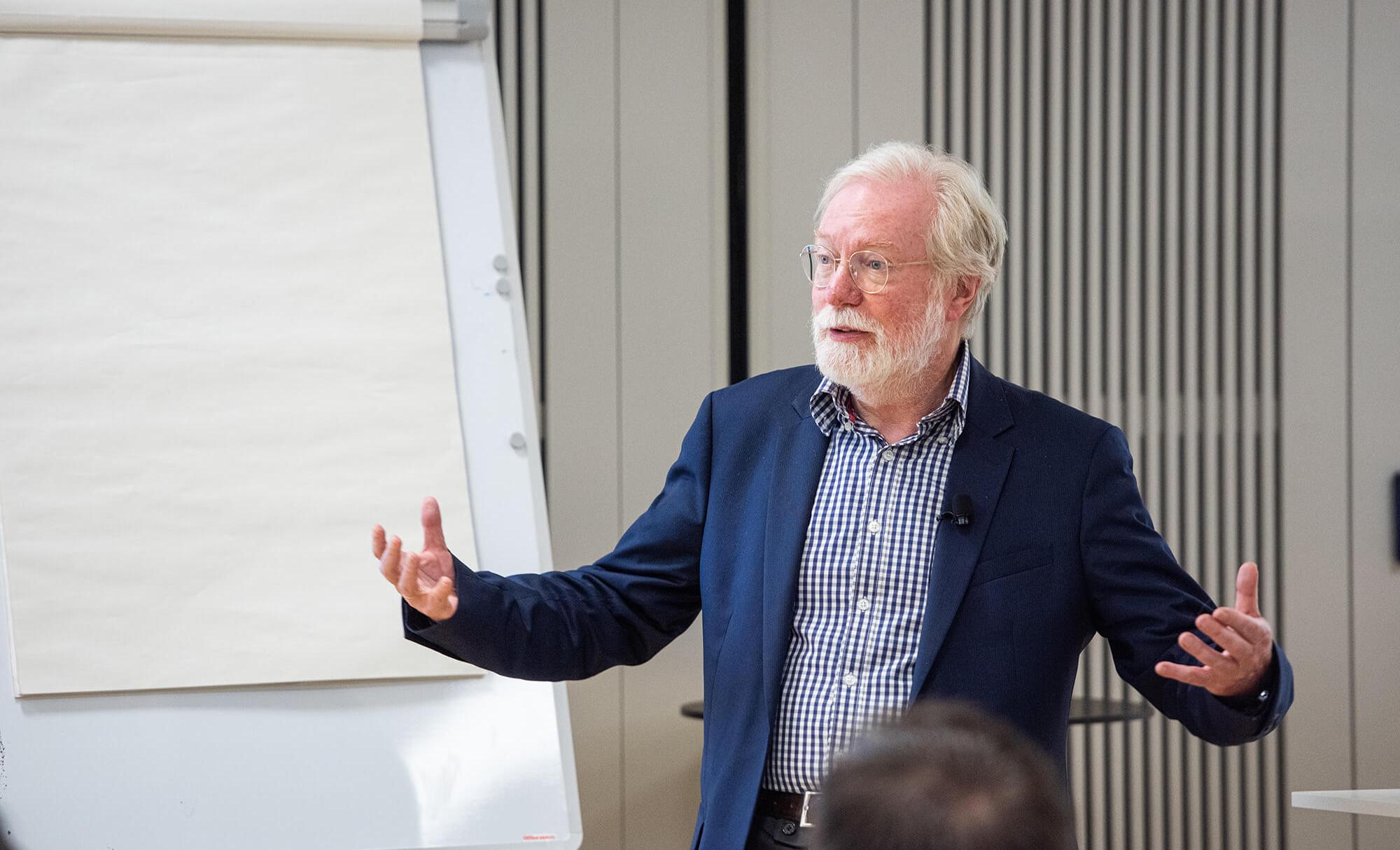
After a career spanning six decades, renowned development economist Professor Sir Paul Collier has retired, leaving a rich legacy of research, teaching and real-world impact.
A founding member of the Blavatnik School of Government, Paul – a world expert on development, poverty, and the political economy of low-income countries – has been a central figure in its history. His career has embodied an idea at the heart of the School: that rigorous academic research can and should engage directly with the difficult choices facing governments and public leaders.
“Over the course of his career, Paul has been driven by an aspiration to make economics better, richer, and more aligned with human possibilities,” says Professor Ngaire Woods, Dean of the Blavatnik School. “He helped every step along the way as a founding member to make this School a place for people, students, government and thinkers from all different disciplines.”
That commitment to crossing boundaries – between disciplines, between academia and government, and between ideas and action – has characterised Paul’s work. His legacy is both deep and rich, stretching from pioneering research on African economies to new thinking about how governments can revive communities and regions left behind by economic change.
Alongside scholarship, he has been deeply involved in advising governments across the world. He has also brought his thinking to a general audience through bestselling books including The Bottom Billion (2007), Wars, Guns and Vote (2009), The Plundered Planet (2010), Exodus (2013), The Future of Capitalism (2018), and Left Behind (2024).
Growing up in Sheffield, Paul attended a state school before coming to Oxford for his undergraduate and doctoral degrees, and has recalled how unusual Oxford seemed at the time given his background: both his parents had left school at the age of 12, and his school had advised him not to apply. His academic career would later take him to chairs at Oxford, Harvard and Sciences Po.
Africa became an early and enduring focus of his work. In 1986 he was one of the founders of Oxford’s Centre for the Study of African Economies (CSAE) and served as its longstanding director, a role now held by the Blavatnik School’s Stefan Dercon. Reflecting on Paul's influence on the world, Stefan describes him as "the best that I've ever seen talking to a policymaker ... I haven't come across a more intuitive mind in economics."
From 1998 to 2003, Paul took public service leave from Oxford to serve as Director of the Development Research Group at the World Bank. The experience fed directly into some of the work for which he became best known: understanding why some countries remain trapped in poverty and conflict, and what governments and international institutions can do differently.
In the latter phase of his career, Paul turned his attention to another form of economic divergence: the fortunes of ‘left-behind’ places within wealthy countries. The economic decline of his native Sheffield helped inspire work on regional inequality, social cohesion and the responsibilities of business and government.
He has also sought to rebalance the discipline of economics towards a more realistic – and positive – view of human behaviour. “People are capable of selfishness but also deeply pro-social behaviour”, he says, “and both economics and public policy must recognise both of these faces.”
A Fellow of the British Academy, Paul’s many honours and awards include a CBE, a knighthood, and the British Academy President’s Medal.
At the Blavatnik School, his legacy is as much about students as scholarship. “I open my classes by telling them that the immense collective talent in that room is greater than what’s in my head alone,” he says. “I urge them to learn from each other; and of course I learn from them too, as a good teacher should.”
Ngaire Woods says: “Paul’s love of the classroom, his sheer, unstoppable joy at teaching, has shone through the years. The thousands of students, researchers and academics who have passed through our doors are richer for having known him.”
Sir Paul Collier is now an Emeritus Professor at the Blavatnik School.
Recent news