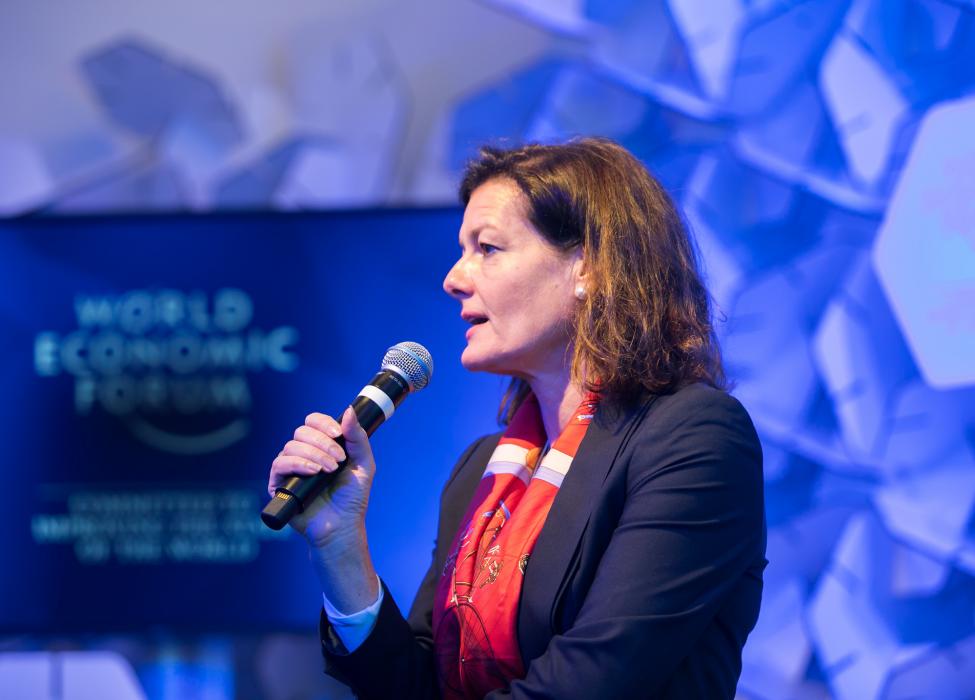
Ngaire Woods at Davos in 2018. Photo: World Economic Forum / Ciaran McCrickard.
This week world leaders will be gathering in Davos for the annual meeting of the World Economic Forum. Starting today, the theme for this year's meeting is “Globalisation 4.0: shaping a global architecture in the age of the fourth industrial revolution”.
Under the premise that globalisation is undergoing deep transformations – mainly due to the challenges of multipolar global powers, technology and climate change – representatives from governments, international organisations, business, civil society and more will meet to discuss how the world can be better prepared for these changes.
Professor Ngaire Woods, Dean of the Blavatnik School of Government, is a regular attendee and speaker at the World Economic Forum annual meeting. This year we would like to highlight the following two sessions which will be available to the public either in livestreaming or recording.
Mapping data dominance – Thursday 24 January, 09:45 CET
As data becomes a new currency exchanged across markets and borders, a development fault line is opening between data-rich and data-poor countries. What are the building blocks of a new development agenda for the data economy?
Livestreaming at the link below.
What should globalisation 4.0 look like? – Friday 25 January, 08:00 CET
The next wave of globalisation will be shaped by the Fourth Industrial Revolution. What global architecture do we need to ensure it is safer, fairer and more sustainable than in the past? What values should underpin it and what forms should its institutions take? Set the Globalisation 4.0 action agenda with members and Co-Chairs of the World Economic Forum's Global Future Councils.
A recording of this session will be available later in the day on the World Economic Forum website.
Recent news