

The ‘Megaphone Paradox’: why the age of protest is not the age of change
Parth Adhikari, Master of Public Policy student, explores why civic mobilisation is not translating into durable political change, and what policymakers should do to address this.
We live in an age of protest and yet durable political change has never been harder to secure. From Dhaka to Nairobi, from London’s motorways to the streets that filled after Mahsa Amini’s death, civic action is abundant. But the bridge from the streets to the state is not. This is the ‘Megaphone Paradox’: an era in which civic voices are louder than ever, but political systems are increasingly organised to absorb, fragment or outlast them.
More than 173,900 protests and riots were recorded globally over a single year in a recent count, yet 73% of the world’s population lives in countries where civil society is either closed or repressed. Dissent has not disappeared. The problem is that the channels through which dissent becomes policy and institutional reform are under strain.
Why volume is not enough
Formal deliberative institutions, such as parliaments and legislative committees, frequently exclude those most affected by political decisions. Protest, in that light, is not a rejection of democracy but a rational response to the failure of its official channels. That helps explain why people keep returning to protest. It also reveals the essential limit: presence is not the same as leverage.
As protest events multiply across causes and countries, turnout alone carries diminishing agenda-setting weight – a kind of protest inflation. Research on civil resistance shows that broad, sustained participation is strongly associated with political success, but scale alone is not enough. What matters is whether a movement can keep its demands clear, sustain internal discipline, and connect its pressure to the mechanisms that actually produce change.
Protest changes outcomes most reliably when it finds an institutional hinge, such as an elite ally, a vulnerable governing coalition, or a court or legislature prepared to act. The important question is whether grievances can find a mechanism of translation. The gap between filling the streets and changing what the state does is where most movements stall.
When it works
Bangladesh in August 2024 is a recent example of conditions converging. Student protests over civil service quotas advanced the fall of Sheikh Hasina’s fifteen-year government not simply because of their scale, but because sustained civic pressure eroded the army’s willingness to act against civilians. The army chief had told Hasina that troops would not enforce her curfew, with the death toll among protesters already reaching at least 241.
The movement did not overthrow the government by force of numbers alone. Rather, it created the conditions under which the institution with actual coercive power chose to withdraw it. Institutional defection, triggered by civic pressure, is how the street can translate into political change.
Kenya in 2024 shows both the potential and its limits. The #RejectFinanceBill2024 movement forced President Ruto to withdraw the Finance Bill by concentrating protest around a specific, legible economic demand. Yet the wider crackdown was severe, with more than 60 people killed. The movement won its immediate goal, while also showing how quickly a government can move from policy accommodation to a security response once it decides to recast protest as a threat to order.
An important complication
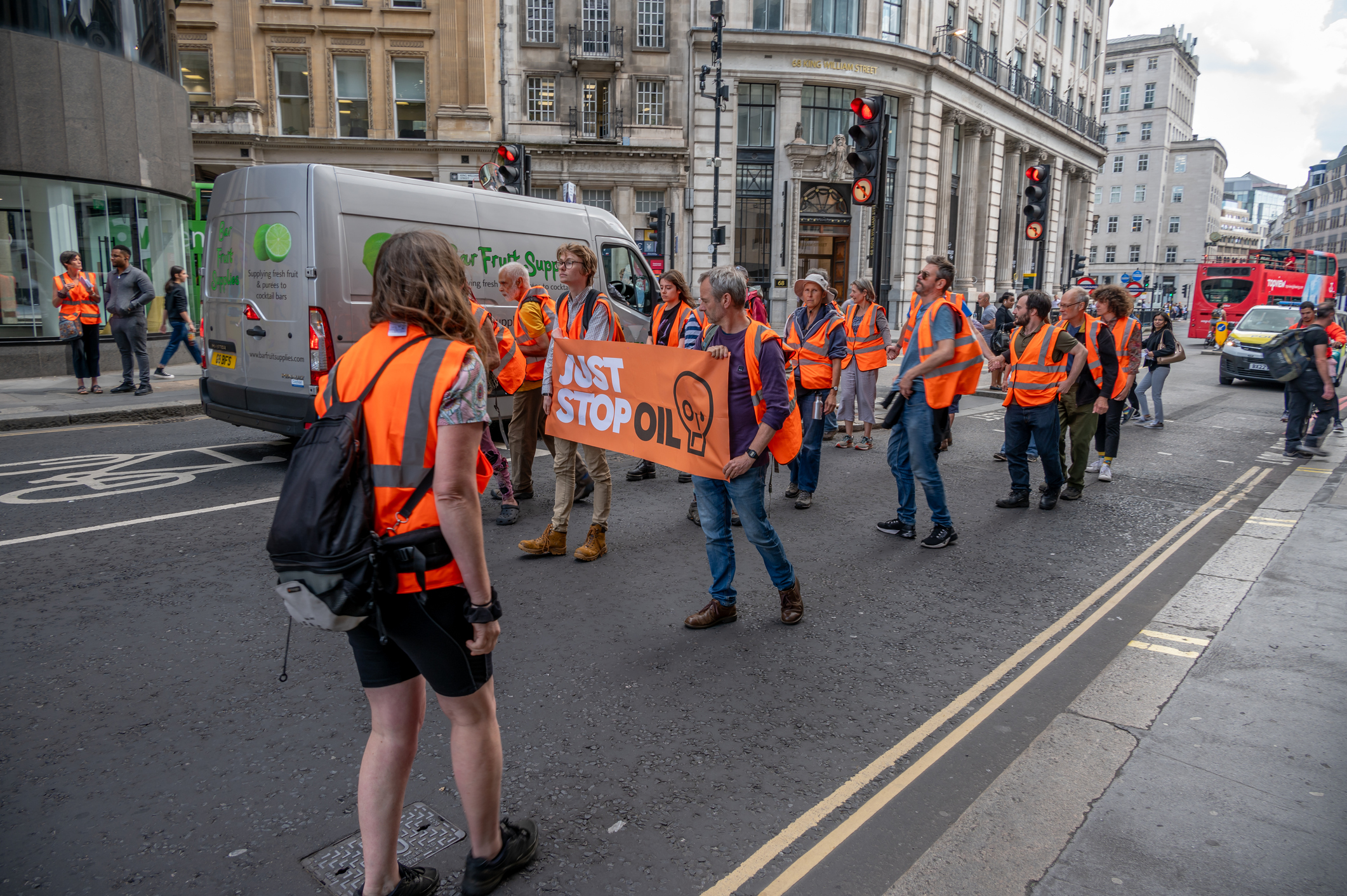
Not every disruptive protest fails on its own terms. In November 2022, Just Stop Oil blocked London’s M25 in a week-long campaign that generated considerable public anger. Research published in Nature Sustainability found that as awareness of Just Stop Oil increased, support for Friends of the Earth, a more moderate climate organisation, also rose. This is what researchers call ‘the radical flank effect’: where a confrontational flank can create space for a more institutionally legible actor to advance. What fails consistently is undifferentiated volume. What occasionally works is coordinated contrast between different modes of pressure within a broader movement.
Where protest hits its ceiling
Iran provides the definitive counter-case. The Mahsa Amini protests of 2022 were among the largest sustained uprisings the country had seen since the Islamic Revolution of 1979. Amnesty International reported hundreds unlawfully killed and tens of thousands arbitrarily arrested. Yet the movement had no institutional lever to pull with no parliamentary bloc capable of acting, no visible split in the security apparatus, and no legal channel through which mass pressure could become state action. Grievance, legitimacy and international visibility were all present. The bridge to the state was not.
That absence is becoming more common. Civil society is under severe attack in 122 of 198 countries and territories. In December 2025, the United States was downgraded from “Narrowed” to “Obstructed”, joining France and others in that category. Across 45 American states, 384 anti-protest bills have been introduced since January 2017, 57 of which have been enacted. The institutional architecture that connects civic pressure to democratic response is being contested even in long-established democracies.
What policymakers should do
The Megaphone Paradox is a governance failure as much as a movement failure, and it calls for a governance response.
Democratic governments should create and properly resource standing channels through which organised civil society can present concentrated demands without having to prove seriousness through mass mobilisation first. Citizens’ assemblies, formal consultation processes, and independent ombudspersons can all play this role when well designed and insulated from capture. The street should not be the only road to institutional response.
Translation requires institutional allies. Sympathetic legislators, legal advocates, trade unions, local authorities and professional bodies are not peripheral to political change. They are often the mechanism through which change becomes lasting. Policymakers who want responsive systems should actively cultivate these intermediary relationships rather than treating civil society as a periodic inconvenience.
Finally, democratic governments should treat the narrowing of civic space as a governance risk, not merely a public-order solution. When lawful channels close, protest does not disappear. It becomes harder to process, easier to repress and more likely to return in more volatile form. Restricting dissent does not resolve the Megaphone Paradox. In many cases, it is what made the megaphone necessary in the first place.
Volume has never been louder. The harder question for policymakers is whether democratic systems still possess the institutional capacity to hear it, and whether those who can act remain connected to those who are speaking.