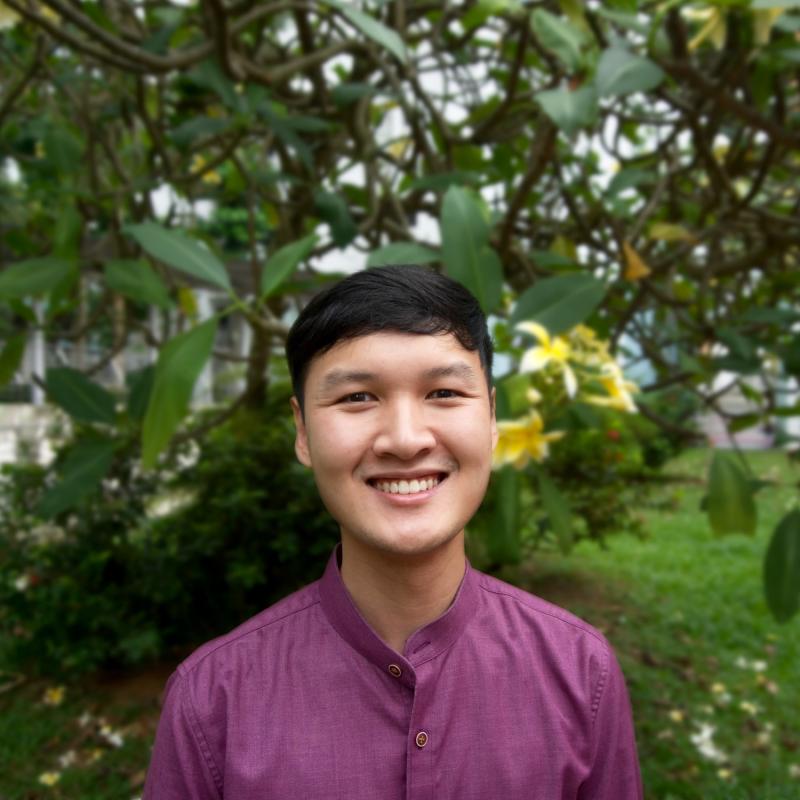
“Dean Ngaire Woods’s opening speech set a powerful tone for the year ahead”, says Nathaniel Chew. Casting his mind back to the first day of the Master of Public Policy (MPP) course, he recalls Ngaire challenging the idea that the goal of the course is “to provide people with a golden escalator.”
“The whole point is that we’re climbing the stairs together and we need to figure out a way to bring everyone up with us–and beyond that, whether we can redesign the stairs themselves to expand access even further. That really resonated with my idea of public service and my desire to make an impact.”
Nathaniel Chew’s journey in public service began with his work for Singapore’s National Library Board. From early literacy programmes to engaging citizens around issues shaping the world, his work explored how public institutions can evolve with society, driven by his belief that libraries are not just places to read, but dynamic civic spaces that adapt to the changing needs of their communities.
“I’ve always known I wanted to work in public service,” he says. “Libraries drew me in because of their ethos: the promise of shared knowledge and open, accessible community space.”
That ethos was tested early. Just six months into his role, the COVID-19 pandemic hit, forcing a dramatic rethinking of how libraries could continue to meet the needs of citizens. Nathaniel’s team quickly adapted, launching an online storytelling programme for children, taking “story time” into the digital realm. It involved negotiating creative rights of books and upskilling librarians to be content creators to connect tens of thousands of families across Singapore. “It started as a crisis response,” he reflects, “but grew into a strategy to bring learning online and into more homes.”
That spirit of adaptation continued to shape his work. Nathaniel helped develop LAB25, a five-year blueprint reimagining the future of libraries and archives. He led initiatives to strengthen the library’s role as an equaliser, a memory institution, and a platform for civic participation. This included Catalyst, a programme that brought academics, technologists, and everyday citizens together to explore issues like public trust in AI.
“It was amazing to see people from so many walks of life come together to talk about how AI affects them and work together on solutions to common challenges. Libraries are more than service points. They can be civic spaces where people feel empowered to engage with big questions.”
That rich experience led Nathaniel to the Master of Public Policy at the Blavatnik School. “The MPP felt like a natural extension of the work I was doing, a chance to deepen my understanding of inclusion, participation and resilience through a broader public policy lense.”
He was drawn to the School’s global, interdisciplinary approach. “The emphasis on comparative perspectives and diverse contexts is exactly what I was looking for. I wanted to learn alongside people who approach public service from different directions.”
Highlights of the course so far include Professor Emily Jones’ negotiation training, which helped Nathaniel see negotiation not just as a skill but as a perspective on policymaking itself. “It taught me how governments can create value in pluralistic societies by understanding and balancing different views.”
He also credits classes with Stefan Dercon, Professor of Economic Policy and former Chief Economist of the UK Government’s Department of International Development, for his insights on a systemic view of poverty alleviation and welfare design.
The opportunities to engage world leaders, who “seem to visit the School on a weekly basis”, has been another highlight. “It’s not just the convening power but how the School creates a space where these policymakers from around the globe are able to speak really candidly to the cohort as peers who share a commitment to making a difference through public service.”
A “particularly memorable” experience from this term has been “a chat over coffee that a few of us had with former Indonesian Finance Minister Sri Mulyani Indrawati”.
“Just being able to hear her reflections on her time in government and in politics, and on policymaking in the Southeast Asian context which is very close to home for me, was incredibly meaningful. What stayed with me the most was her emphasis on setting bold, principled ambitions for yourself, even when the circumstances make the prospect of change feel low, daunting or unfeasible. That has really left a mark on the kind of leader I want to be.”
As well as learning from experts and world leaders, Nathaniel points out the learning he’s been doing in informal spaces too, outside of the classroom.
“Hearing about my peers’ previous work experience has been one of the most rewarding parts of the MPP. Even a casual conversation over lunch can teach me so much about a country I’ve never been to. I’m often surprised by how similar the challenges are, things I thought were unique to my context turn out to be shared by places on the other side of the world. It’s easy to assume that solutions can’t be transplanted, but I’ve heard so many great ideas from my classmates that I’d love to explore further.”
“The School does a great job of enabling peer-to-peer learning,” Nathaniel says. “It’s built into the structure, through student-led policy clusters, group work, and open classroom discussions.”
In Professor Emily Jones’s negotiation class, they had a session on the Colombian peace process led by alumna Daniela Vargas. As a member of the United Nations in Colombia, she was involved in the verification of the ceasefire and the laying down of weapons of a former guerrilla. She worked directly with ex-combatants, institutions, communities and international actors on the peacebuilding process. Several classmates from Colombia also shared their own experiences of living through that time and their active role in the peace process.
“It’s something that you could never learn from a textbook. That kind of dialogue is what makes this community so unique.”
Nathaniel is on a Singapore National Library Board scholarship. When he finishes the MPP, he will return to Singapore, where he aspires to strengthen social inclusion and resilience, channelling his new insights to shape how public service evolves to meet the needs of citizens.
His advice for future applicants? Don’t underestimate the value of your experience.
“I would advise anyone thinking about applying to the MPP to lean into their own personal experiences and take their time to reflect on them. I think it's easy to feel that you haven't necessarily made a big policy impact in your career so far, but policy challenges are incredibly diverse. I worried if my background in libraries was “policy” enough. But I’ve come to see it differently: this experience has allowed me to situate what I've learned within wider questions around public service transformations for inclusion, inspired by what I’ve learned from other disciplines and other countries.”