
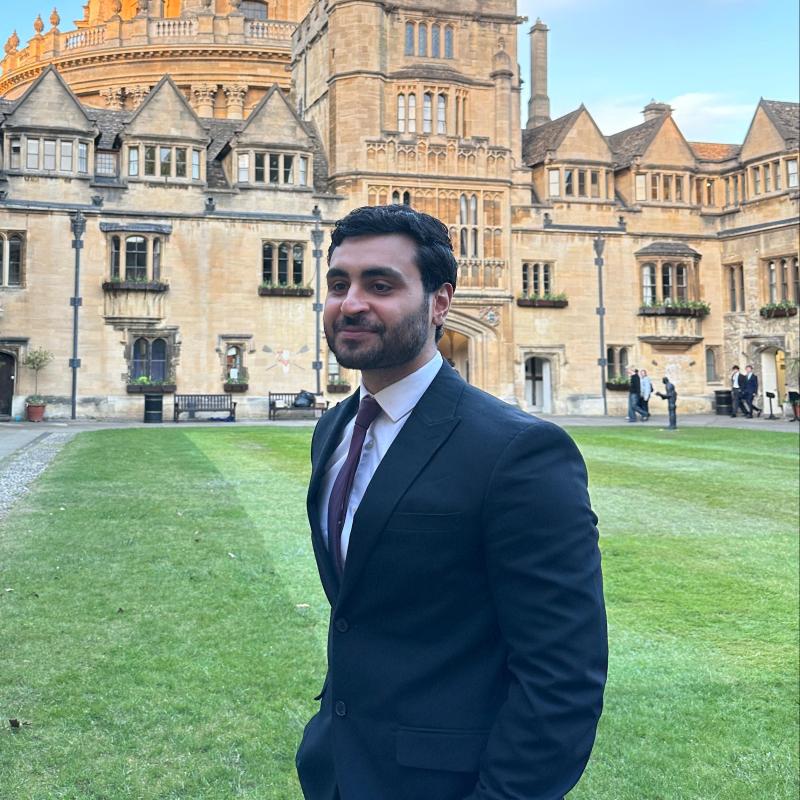
Balaaj Khan first started thinking about public policy during his time as a medical doctor in the UK. Working in primary care and the emergency department, he quickly realised the impact poor policy could have on people's health:
“I saw that a lot of the health problems were caused by educational issues, social policy, housing, wages, welfare, social security – issues that lead to poorer health and economic outcomes”.
Alongside his work in medicine, Balaaj also became passionate about improving career pathways for disadvantaged groups. “I chaired a widening access programme that supported disadvantaged students with getting into medical school. It was all about opening doors and providing opportunities.”
Over time, Balaaj realised he wanted to move beyond treating the effects of these issues and instead help shape the systems behind them. “As much as I love medicine, I wanted to have an impact on a bigger scale”, he reflects. He became involved with the Labour party, advocating for better educational access, mental health reform, advocacy in schools and economic prosperity.
That experience soon led him to the Master of Public Policy, where he was particularly attracted to the opportunity to learn alongside a globally diverse cohort. With 141 students representing 63 nationalities, Balaaj says one of the most valuable aspects of the course has been learning from his classmates:
“Everybody is highly skilled in their own arena, and they have their own lived experience that they bring to the classroom. Every discussion challenges you to see an issue from another perspective”.
He also values learning alongside students with different political views to his own, and the way the School creates space for open discussion. “It’s pushed me to think beyond my own assumptions and to see what I might be missing, to really understand why people believe what they believe”.
He also credits the School’s breadth and teaching style with helping him grow in confidence as a policymaker. “The course has deepened my understanding of how economics, law, politics, philosophy and history shape policy”. He adds “learning via the case method in particular has been incredibly impactful because it allows you to apply theory to real-world situations. You’re not just learning what decisions were made – you’re understanding why they were made, what the alternatives were and what the consequences looked like in practice.”
Now in Trinity term, Balaaj is studying topics including war and global security, climate and crisis leadership. “I’m really trying to understand things from a broader perspective”, he shares. “I want to shift away solely from being ‘the health person’ to really understanding economic policy, social policy, national policy and security as a whole.”
The Dean’s Forums – exclusive fireside chats with global leaders and policymakers – have also been a highlight. A conversation with former Prime Minister of New Zealand Jacinda Ardern was particularly memorable. “She spoke specifically about how she united people and led in a time of crisis. It was so helpful to hear directly from someone with that level of experience.”
Discussions on technology, economics and social policy with individuals such as the UK Ambassador to the US Sir Christian Turner, and the former Governor of the Bank of England, alongside conversations with his professors, have left a lasting impact.
“They have really allowed me to learn firsthand from leaders across the globe who are highly skilled in their arena and to hone my leadership and policy skills”.
Balaaj is one of two Political Leadership Scholars in this year’s cohort. The scholarship is for students from the UK and Ireland and aims to improve the diversity, calibre and training of public leaders. “I’m really grateful. It’s given us the opportunity to come to the School and to connect with a network of other Political Leadership Scholars. It’s been very valuable.”
As his time on the MPP nears its end, Balaaj is excited to apply his deepened understanding of policy to the real world.
“Oxford has given me perspective, purpose and a community of people committed to public service,” he says.
To those considering applying for the MPP, his advice is simple: “This is the place. This is the course. This is the community that changes you and the world around you”.