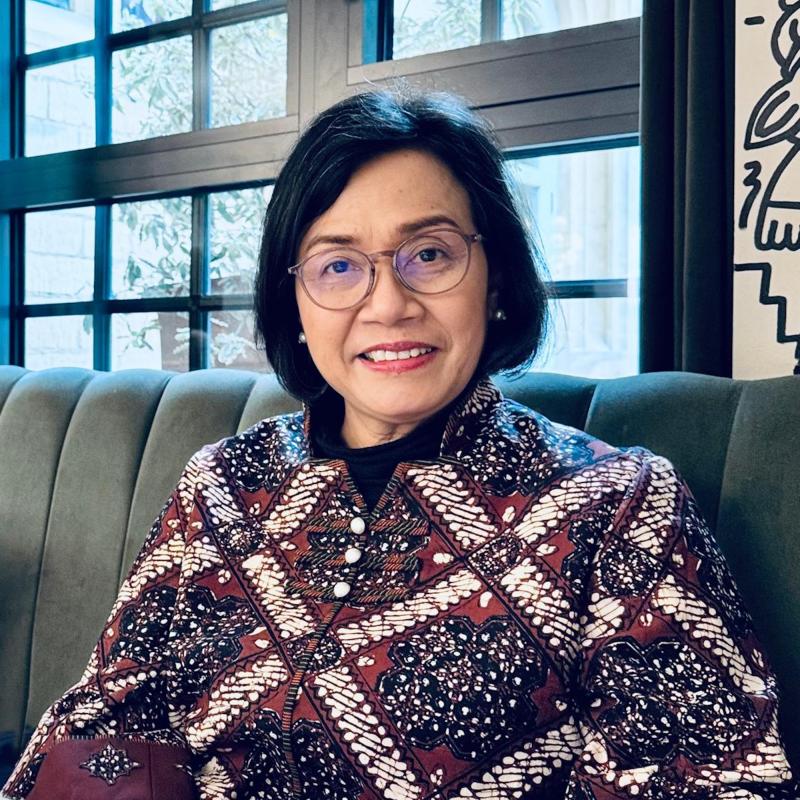
Sri Mulyani Indrawati is Blavatnik World Leaders Fellow 2025-26. She is one of Indonesia’s longest-serving - and first female - Ministers of Finance, having served under three democratically elected presidents. Across her tenure, she steered the country through profound global and domestic shocks while advancing three core objectives: sustaining economic growth, creating employment, and reducing poverty and inequality. She restored and safeguarded fiscal discipline, strengthened macroeconomic stability, and upheld institutional integrity. Under her leadership, Indonesia’s sovereign credit rating rose from selective default following the Asian Financial Crisis to investment grade, anchored in credible and prudent fiscal and macroeconomic management.
A transformative reformer, she led the comprehensive modernization of the Ministry of Finance, overseeing more than 80,000 personnel. Her reforms strengthened public financial management; enhanced transparency and accountability; digitized tax, customs, and treasury systems; established Indonesia’s first fully integrated digital Treasury Single Account; introduced performance-based management; and significantly advanced anti-corruption efforts.
She played a central role in restoring investor confidence and stabilizing the economy through three major global shocks: the Asian Financial Crisis, the Global Financial Crisis, and the COVID-19 pandemic. She pioneered major innovations in Indonesia’s financial architecture, including the establishment of the Indonesia Investment Authority (INA), the country’s sovereign wealth fund designed to mobilize global capital through blended finance and public–private partnerships. Under her leadership, Indonesia emerged as a global leader in green and sustainable finance, issuing the world’s first sovereign Green Sukuk from an emerging economy, followed by SDG bonds—both achieving record-low financing costs. She also played a key role in shaping the Just Energy Transition Partnership (JETP) and advanced disaster-risk financing initiatives, including insurance schemes for subnational governments and pilot programs for agricultural and farmer insurance.
During the COVID-19 pandemic, she directed Indonesia’s fiscal response with precision—balancing urgent health and humanitarian needs with economic stabilization and recovery through targeted and time-bound stimulus measures. Indonesia’s post-pandemic recovery ranked among the fastest and strongest globally, while maintaining prudent public debt levels.
She promoted the strengthening of the national health system and supported the development of sustainable universal health coverage in close collaboration with the Ministry of Health and the national health insurance agency. She also supported nationwide and local programs to reduce child stunting.
She established a sovereign education endowment fund that has supported more than 50,000 Indonesian students pursuing higher education at leading universities worldwide. A strong advocate for gender equality and financial inclusion, she expanded access to finance for women-led micro and small enterprises and accelerated the digitalization of social assistance programs for low-income households.
Internationally, she is a steadfast champion of multilateral cooperation. She elevated Indonesia’s leadership within ASEAN, the G20, and the OECD accession process, and across multilateral institutions including the World Bank, IMF, Asian Development Bank, Asian Infrastructure Investment Bank, and Islamic Development Bank. Her work has advanced reforms in global taxation, climate finance, and inclusive development. She currently serves as a member of the Board of the Gates Foundation.
Prior to her ministerial service, she was Managing Director and Chief Operating Officer of the World Bank, overseeing operations in more than 100 countries. In this role, she strengthened institutional performance, deepened engagement with client countries, and promoted gender equality, education, and inclusive growth, while serving as a key bridge between developing countries and global financial institutions.
Earlier in her career, she served as Executive Director at the International Monetary Fund (2002–2004), representing 12 countries in the East Asia and Pacific region during a period of significant financial stress across emerging markets.
Her leadership has been widely recognized through numerous international honours, including:
- Best Minister in the World, World Government Summit, Dubai (2018)
- Euromoney Finance Minister of the Year (2006)
- Best Finance Minister in Asia, Emerging Markets (2006, 2008)
- Regular inclusion in Forbes’ World’s 100 Most Powerful Women
Related
