
When academic fields meet, new insights on polarisation emerge
João Pedro Caleiro, Writer-Researcher from the Lemann Foundation Programme, reflects on a recent workshop bringing together different scholars and disciplines to shed light on the phenomenon of rising dislike between those with different political views.
Open a news website, speak to a friend, or wander around the Blavatnik School and chances are that polarisation will soon enough appear on the page or in conversation, and often tinged with concern. However, for a topic of such importance, it might come as a surprise that polarisation is a somewhat slippery object of study for academics.
Firstly, consider the key distinction between ideological and affective polarisation. While ideological polarisation is about differences in policy positions, affective polarisation is about dislike of those in a different political group to your own. The evidence suggests that when your identity is tied to your political belonging, this can lead to hostility, discrimination, motivated reasoning, and a highly distorted view of your political out-group and their positions – and therefore to more difficulty reaching compromises.
Affective polarisation is often measured in surveys with “feeling thermometers”, asking how much you like your political ingroup versus how much you dislike your political outgroup. This presents a series of challenges for researchers. How do we accurately differentiate, for example, animosity towards political elites and leaders (known as vertical polarisation) from animosity towards citizens from an opposing political camp (known as horizontal polarisation)? How does liking or disliking relate to dimensions that might underpin these attitudes – fearing the “other” group, or feeling angry at them – or are emotions fundamentally different and weakly related? When people report attitudes and feelings in surveys, are they describing something transient or something permanent, something deep-seated or merely performative?
Moreover, much of the work on affective polarisation focuses on the United States, a clear-cut bipartisan system where there is evidence that affective polarisation has been outpacing ideological polarisation since the 1980s. But how do we define political ingroups and outgroups in the coalition-based political systems of Europe? Or in Brazil, where ideology is less consistent? All things considered, tracking affective polarisation across countries and time is a challenge.
Note that so far, we have not even touched on many of the phenomena often associated with increasing affective polarisation – from rising inequality to democratic backsliding – or on affective polarisation’s relationship with gender and race. What emerges is a field that is hugely relevant for understanding the state of our world today, but that is entangled in a series of complexities.
Anna Petherick, Associate Professor in Public Policy at the Blavatnik School, along with Eelco Harteveld and João Areal Neto, from the University of Amsterdam, has studied affective polarisation for some time and thinks the field could benefit from some cross-pollination with other disciplines. This means bringing together scholars who have engaged with some of these themes from different perspectives to look over the fence at work that others have done, in philosophy, anthropology and history, for example. Enter the “Affective Polarisation Meets Its Neighbours” workshop.
The “Affective Polarisation Meets Its Neighbours” workshop
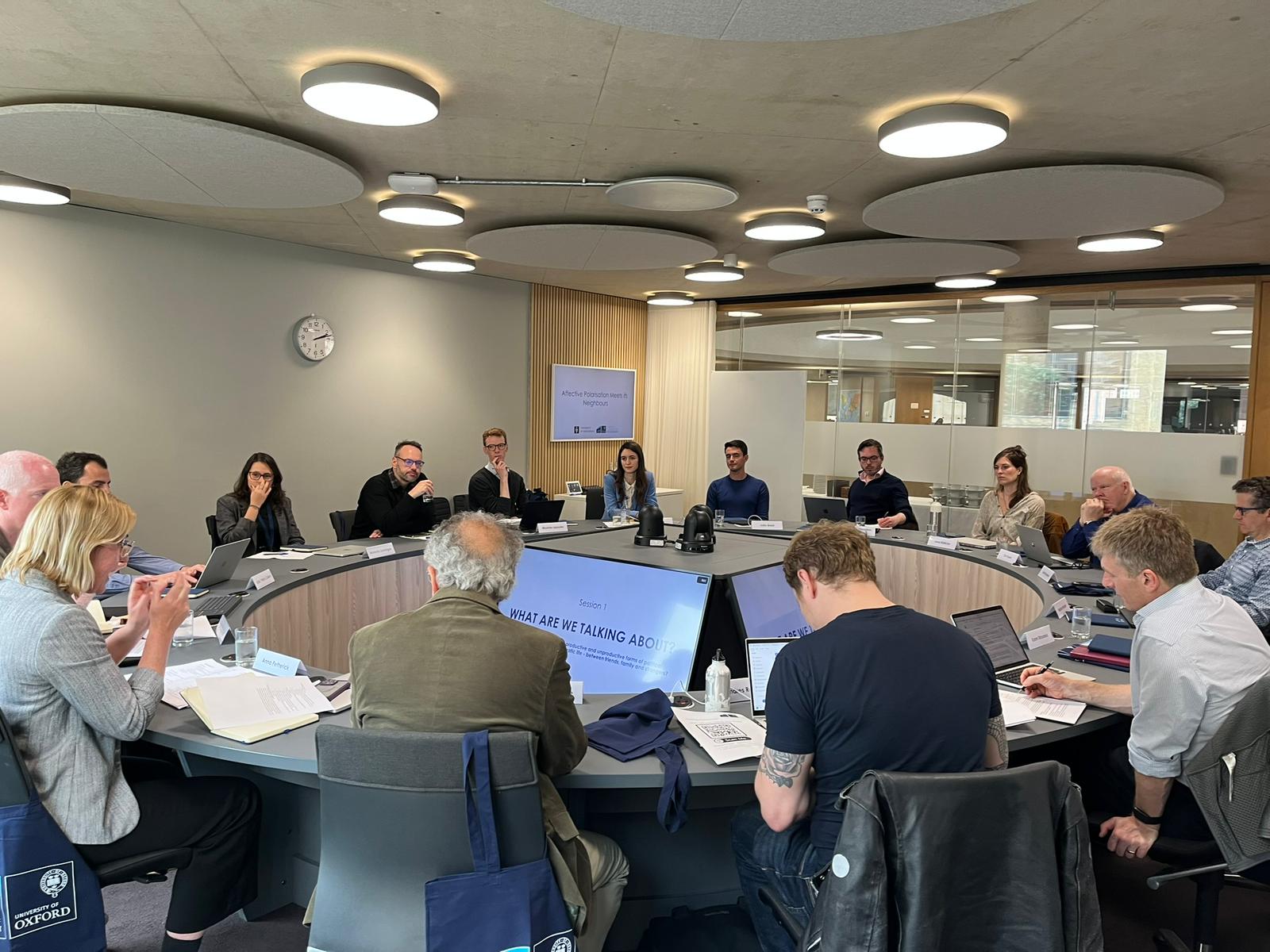
This two-day workshop, held at the Blavatnik School in May 2026, brought together about 20 scholars from universities across the United Kingdom, the Netherlands, the United States, Austria, Sweden, Germany and Estonia, representing a range of disciplines including political science, philosophy, sociology, peace and conflict research, social data science and Brazilian studies. It was supported and organised by the Lemann Foundation Programme, a research and engagement programme at the Blavatnik School with a strong emphasis on Brazil, a country where polarisation appears to have grown over the past decade.
The idea of the workshop was to explore the intersections between affective polarisation and other fields of knowledge. So instead of the usual academic business of requesting papers to be presented and then critiqued, the organisers opted for a different approach, sending questions for reflection in advance, holding individual calls to encourage participants to start brainstorming, and then, in the workshop, seating them around a roundtable for a moderated conversation. Everyone was encouraged to share thoughts and generate ideas, embracing improvisation and the spirit of the social sciences as a team sport.
“This workshop on polarisation proved the opposite of its subject: we listened across difference, built on each other’s ideas, and confessed to shared confusions. What fun! It was a risk to dispense with the presentation of papers and simply invite responses to questions circulated in advance, but the individual preparation calls and the care with which the questions were framed produced a lively, thoughtful, and incisive discussion with plenty of respectful disagreement”
Chris Stone, Professor of Practice of Public Integrity at the Blavatnik School, who participated in the workshop
The workshop strategy paid off in interesting ways. Firstly, by encouraging conceptual clarity and the dissection of hidden assumptions: for example, are we worried about polarisation or really only about extremism? Could there be upsides to polarisation, in terms of increasing mobilisation and representation? Secondly, by illuminating the relevant relationships between affective polarisation and other areas. While the anthropologists and scholars of peace and conflict in the room examined the specifics of how and when polarisation could devolve into dehumanisation and political violence, for example, the philosophers helped scope the frontiers between valuable and dangerous forms of political disagreement.
Meanwhile, psychologists brought up the anxiety and stress reaction mechanisms triggered by living in highly polarised societies, and those in communications showed how the way we communicate shapes polarisation today. The impersonal nature of social media erases the interpersonal cues that encourage empathy, for example, while its algorithmic architecture thrives on triggering negative emotions and risks creating echo chambers. One question for future research is how artificial intelligence could be used as both a polarising (or depolarising) force.
Previous depolarisation episodes in history and the mechanisms associated with them can also be a valuable source of learning, and experiments in this area are part of ongoing research by Anna Petherick and partners from Getulio Vargas Foundation (FGV-EBAPE, based in Rio de Janeiro). Recently, they published a paper in Nature Communications about a promising method of reducing affective polarisation.
Rather than aim for definitive answers or new theories, the group, as expected, ended the workshop, as one participant put it, “confused on a more sophisticated level”. There were several suggestions of new research avenues and policy interventions that could one day lead to a less antagonistic politics and the restoration of trust and better cooperation among political adversaries. In a world like ours, that would be no small feat.