

The unfulfilled promise: how data interoperability can power AI for public good
Heleno Nunes Filho, MPP 2024, proposes a four-step roadmap for governments to overcome data fragmentation and build robust digital public infrastructure.

Governments worldwide have been digitising processes and offering government services online for decades.
In recent years, these same governments have started to use artificial intelligence (AI) to enhance oversight efficiency and public service delivery. However, these advancements are merely digital plumbing to raise productivity and bring convenience to citizens. To truly harness the game-changing potential of digital technologies, we must do more – we must bring data into the heart of government.
As Daniel Lim Yew Mao argues, this transformation hinges on recognising data as a strategic asset. A greater use of data allows governments to shape policies based on evidence-based insights instead of trial and error; foster proactive, coordinated responses over reactive, fragmented ones; and deliver more anticipatory, personalised services.
Although many governments hold terabytes of data, much of it remains fragmented and disconnected. This siloed approach to data management frequently proves inefficient. It fails to effectively track, interpret, or respond to the growing volume of complex data or to capture vital connections across interdependent policy areas – both essential for swift, evidence-based decisions.
The common narrative around AI often highlights the machine learning code supporting it; however, its real power and potential are the vast amount of administrative data that flows across its systems. This is where governments should be looking to improve their services.
First things first: the power of a strong Digital Public Infrastructure (DPI)
The successful establishment of a comprehensive data interoperability system is not an isolated technical endeavour; it requires a broader institutional transformation. At the heart of this transformation is robust Digital Public Infrastructure (DPI) – a secure, interoperable, and standardised digital system. DPI provides the essential infrastructure for a whole-of-government approach, enabling departments to share data and helping them operate efficiently without duplicating systems.
It is this exchange and integration of data that enables sophisticated tools like the Risk-Based Inspection System (New York City Fire Department) and the AI-powered traffic management (Singapore's Smart Nation) to provide data-driven insights and enable anticipatory actions.
A Four-Step Roadmap for building a consolidated data interoperability system
Lessons from pioneering digital nations like Estonia and Singapore highlight distinct, yet equally effective, approaches to data interoperability. Estonia's X-Road system thrived on strong legal mandates and a "must-share" model, while Singapore cultivated cooperation through institutional collaboration and shared standards.
Building on these international insights, we can draw out a four-step roadmap for establishing a robust and consolidated data interoperability system, tailored for both governments building new institutions (steps 3-1-2-4) and those transforming existing ones (steps 1-2-3-4).
Step 1: Institutional reform and data architecture.
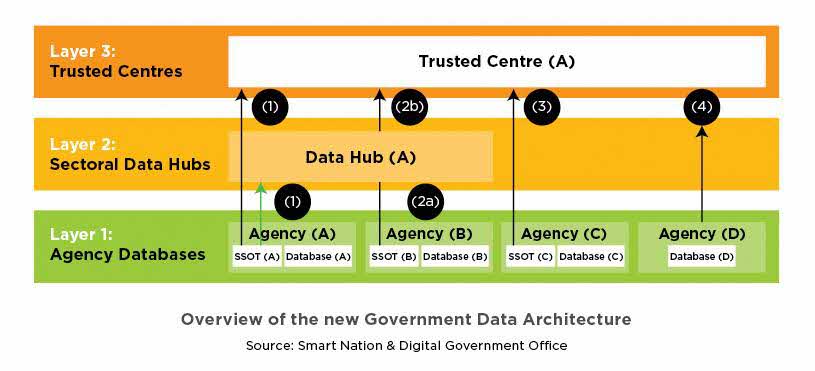
The initial step involves mapping current institutional structures and data flows. It advocates for the creation or strengthening of Digital Government Units (DGUs) with internal in-skilling capabilities. Crucially, it recommends the designation of Single Sources of Truth (SSOTs) for each data domain and the establishment of Trusted Centres (TCs) to aggregate and distribute cross-sectoral data. This foundational step addresses political and institutional barriers. It brings clarity to roles and responsibilities, reduces data duplication, and lays the architectural foundations for data sharing without imposing immediate political and institutional burdens.
Step 2: Interoperability standards and incentives.
At this stage, governments should establish standard metadata formats, programming languages, and APIs as the default for all data exchanges. This is the inflection point where path dependence can shift from historical trap to leverage. Standards are often not adopted due to lack of immediate benefits, while benefits don't exist because few have adopted standards. The key is to offer attractive trade-offs (e.g., reduced manual data reconciliation efforts) and valuable "meta-products" (e.g., the universal identity platform of Estonia's ESTEID, which offered banks a broad, free user base) to early adopters, creating compelling reasons for agencies to embrace these standards. This approach leverages positive feedback loops through increasing returns: as more agencies adopt the common standards, the benefits of participation increase for everyone, making opt-in the path of least resistance. This step primarily addresses technological and cultural barriers, demonstrating immediate practical functionalities and fostering a new institutional culture of data sharing.
Step 3: Institutionalisation via adaptive regulation and organic expansion.
Once initial successes are demonstrated and a critical mass of adoption is achieved, focus shifts to consolidating and expanding cultural change. This involves documenting and disseminating achieved gains through proactive periodic reporting (e.g. Singapore's SPORE). The goal is to create an adaptive regulatory framework that supports organic expansion. This framework should gradually increase the costs of non-compliance while simultaneously elevating the benefits of adherence, by restricting access to advanced functionalities for non-compliant agencies. This psychological and reputational pressure encourages cooperation and helps eliminate free-riders.
Step 4: Leveraging the consolidated DPI for diverse applications (e.g., AMS).
With a consolidated open data culture and a DPI effectively in place, governments are empowered to implement sophisticated digital systems. This final step involves prioritising which areas should receive these new deployments. Prioritisation can be guided by criteria such as programme value, visibility, scaling potential, data availability, social relevance (e.g., addressing issues for vulnerable populations), or legal mandates. With in-skilled teams and user-friendly systems leveraging the DPI, governments can then deliver predictive capabilities and radically improve efficiency across various domains, transforming reactive governance into proactive, evidence-based public administration.
Conclusion
Building a comprehensive data interoperability system fundamentally redefines state capacity, moving beyond mere technological upgrades for the digital age. This roadmap (deep dive here), adaptable and strategically sequenced, enables data flow and integration, crucial for governments to embrace anticipatory, evidence-based governance. By treating data as a foundational asset and fostering cultural transformation, robust infrastructure, and clear mandates, it offers a crucial path to unlock public value, build resilient public service delivery, and restore trust in institutions within twenty-first-century democracies.