

Lessons from the Strait of Hormuz crisis
Parth Adhikari, Master of Public Policy student, explores what the Strait of Hormuz crisis reveals about the limits of coercion and the policy choices needed to reduce vulnerability in an interconnected energy system.
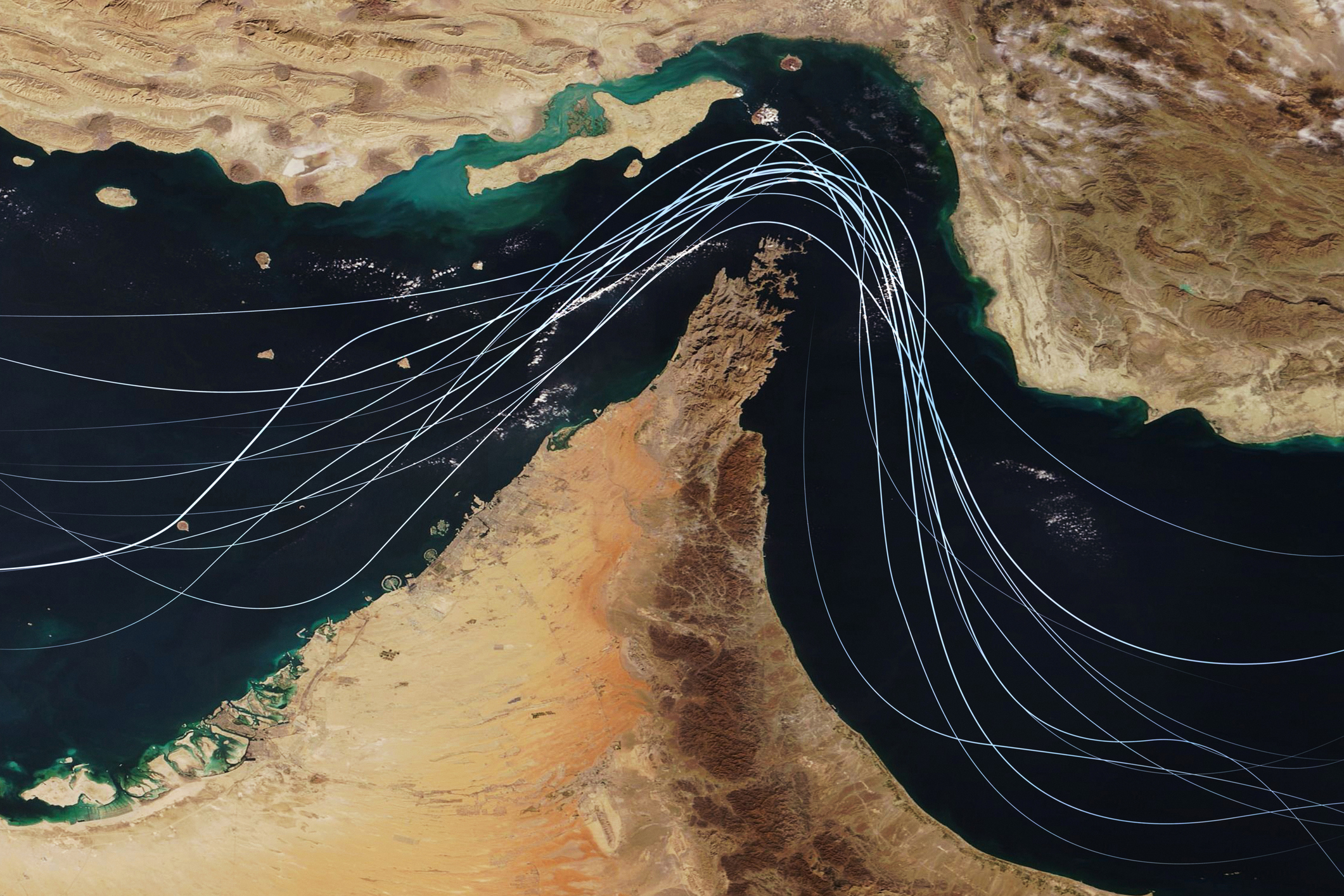
Millions of years ago, the same geological forces that helped form the underground conditions for the Gulf’s vast oil reserves also created the narrow passage through which much of that oil must now travel: the Strait of Hormuz. Today, the region’s energy wealth and its most critical bottleneck sit directly on top of each other.
On 28 February 2026, this structural vulnerability became a crisis. The United States and Israel carried out coordinated airstrikes on Iran, killing Supreme Leader Ali Khamenei and hitting nuclear and military sites across the country. Within hours, Iran’s Revolutionary Guard Corps announced the closure of the Strait to shipping. About 150 vessels dropped anchor, and daily traffic fell from around 150 ships to fewer than 20. The International Energy Agency (IEA) described what happened next as "the largest supply disruption in the history of the global oil market," with Brent crude prices climbing toward $120 a barrel. IEA member countries released 400 million barrels from their strategic reserves (approximately twenty days’ worth of normal Hormuz traffic of 20 million barrels per day), which provided some relief but did not resolve the problem.
The central paradox of what transpired between the start of the conflict and the declaration of two-week conditional ceasefire on 8 April is that Iran found itself trapped by the same geography and interdependence it had tried to ‘weaponise’, with its own oil revenues dependent on the Strait it declared closed.
Why this chokepoint is different
To understand why, it helps to compare Hormuz with other economic pressure points in great-power competition. When the United States used its influence over SWIFT to pressure Iran into nuclear negotiations, or when it restricted China's access to advanced semiconductors, it was exploiting its control over critical hubs where it was insulated from the ramifications, while its adversaries were badly affected.
The Strait of Hormuz inverts this relationship. When Iran tried to use it as leverage, it simultaneously blocked its own economic artery. Iraq, Kuwait, Qatar and Bahrain have no meaningful export routes as alternatives to Hormuz. Even the bypass pipelines available to Saudi Arabia and the UAE can cover only an estimated 3.5 to 5.5 million barrels per day. The actor pulling the lever was just as exposed to the consequences as those it sought to pressure.
You could call Hormuz a ‘reflexive chokepoint’: a critical node within a strategic network where any attempt to exploit control results in immediate and proportionate self-harm, because the leveraging state is dependent on the node along with its adversaries. This is not simply about shared costs deterring belligerence on both sides. At a reflexive chokepoint, partial disruption remains rational for a state fighting for its survival, even when full closure would be self-defeating. Iran’s Revolutionary Guard Corps did not shut the Strait completely since Iran can ill-afford it. It throttled the naval pinch-point, balancing coercive pressure against economic necessity.
What the crisis shows
The oil-price response illustrates the underlying mechanics. Markets priced in future scarcity before any physical shortage materialised, because forward-looking traders discount expected disruption immediately. Brent crude prices surged even as laden tankers were still completing their voyages. Those in-transit cargoes bought the world some time, as the IEA's March 2026 report confirmed that oil-on-water accounted for 25% of global observed stocks at the time. But with Iraqi storage filling and Kuwaiti capacity tightening rapidly, Gulf producers began shutting in wells, cutting output by at least 10 million bpd. The Dallas Federal Reserve estimated that three quarters of sustained disruption could reduce fourth-quarter global GDP growth by 1.3 percentage points. Emergency reserves stabilise markets, but they cannot restart upstream production that has been switched off.
The most important detail here was what Iran ultimately did with the closure. Maritime tracking data reported a transit fee being charged for safe passage across the IRGC-controlled Strait. The criteria for access evolved as April approached. It was initially restricted to vessels without direct US or Israeli ties, and subsequently, French- and Japanese-linked shipping had also begun to move through. The chokepoint had converted itself, under pressure from its own economic contradictions, into a graduated tollbooth arrangement.
The entrapment in real time
As of early April 2026, the mutual entrapment was perceptible from every direction. The President of the United States issued successive ultimatums threatening to destroy Iranian infrastructure if the Strait was not reopened. Iran, in turn, threatened retaliation against regional energy facilities. The United Kingdom convened over 40 countries on 2 April to discuss reopening the passage, without the United States at the table, despite it being the major belligerent in the war that has closed the Strait. France called reopening it by force "unrealistic" while bombing continues. This pattern of escalating threats, partial use, graduated access, with no clean exit for anyone, is a pattern that a reflexive chokepoint is capable of producing. Accepting the two-week ceasefire conditional on Iran reopening the Strait, Iran has specified that the passage would be "via coordination with Iran's Armed Forces". Even in the agreement that has paused the war, the pattern of graduated access is visible.
Lessons for policymakers
The legal position is clear enough. UNCLOS Part III establishes a transit-passage regime that bordering states cannot suspend, and many legal analysts treat this as customary international law binding even on states, such as Iran, that have not ratified the Convention. Iran disputes this, and the law could not by itself physically reopen a passage that a naval threat has closed. What the legal framework does provide is the principle on which international pressure can be organised, and that still remains important. The more durable lessons are architectural, and point to three things governments can actually do.
More durable lessons lie in how governments manage exposure to the Strait itself. Expanding Saudi Arabia's East-West pipeline and the UAE's Fujairah corridor is, at this point, as much a security investment as an infrastructure one. The available bypass capacity currently covers less than a third of normal Hormuz throughput. Every barrel that can leave the Gulf without passing through the Strait reduces the vulnerability that makes this trap possible for exporters and importers alike.
Strategic petroleum reserves also need to be reconsidered. The IEA's coordinated release of oil can stabilise markets in the short term, but does not resolve underlying problems. National and international reserve policies need to be sized and governed for protracted disruptions, including possible upstream production losses.
Among the most exposed importing economies – Japan, South Korea, and India – the case for diversification is now even clearer. Developing faster, credible pathways to alternative suppliers and investing in the domestic energy transitions that reduce oil import dependence altogether is the long-term resilience that a single chokepoint, however critical, should not be able to undermine.
The geology of the Strait of Hormuz is unlikely to change on any timescale relevant to policymakers. What governments can change is how exposed they allow themselves to be to a waterway that no one can afford to close.
The world's energy strategists need to start planning ahead.