

Learning how to lead in the ‘age of outrage’
Alice Hopkin (MPP 2025), former UK Special Adviser to the Foreign Secretary, Home Secretary and Secretary of State for Health & Social Care, shares her insights from the Master of Public Policy course ‘How to Lead in a Polarised World’, describing how it both resonated with and reshaped her approach to public service. Alice is a 1+1 MPP & MBA Pershing Square Scholar.
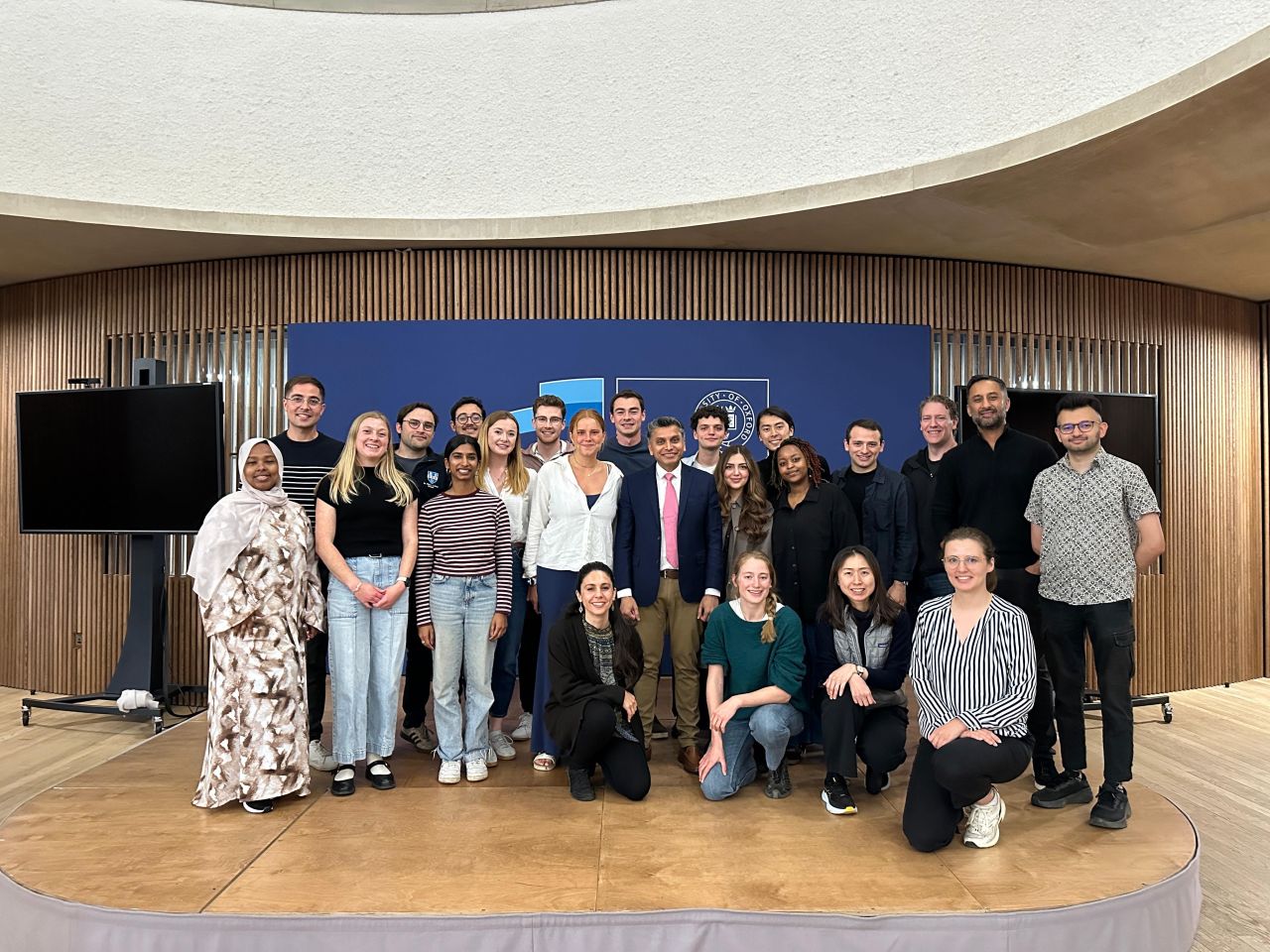
Politics today feels louder, faster and more emotionally charged than ever. Globalisation and technology have brought people closer together, but have also exposed new policy challenges and sharper clashes of identity, values and interests. In an age of sensationalist media, economic warfare and a fraying rules-based order, it is hard to imagine a timelier course for anyone interested in public leadership than How to Lead in a Polarised World, led by Karthik Ramanna, Professor of Business and Public Policy at the Blavatnik School.
I chose this module for its unapologetically practical content, and it did not disappoint. After two terms of deep academic teaching, I wanted to stress-test what I had learnt against real-world situations. Across seven case studies – a migrant crisis in Brazil, stop and search in London during Covid, the Maggi noodle safety crisis in India, peace-building in Kaduna State, Margaret Thatcher's rise to power, Covid-19 at Oxford University Hospitals, and President Trump testing institutional boundaries – we examined moments when leaders had to act under intense pressure with incomplete information, divided stakeholders and very little time. They were messy, human and highly political. Not all of them ended well. That, as Professor Ramanna made clear, was rather the point.
Each case study required us to unpick the stakeholder map the protagonist was navigating. Who held power, who needed to be persuaded, and where the real friction lay. As a Special Adviser across the Home Office, the Foreign, Commonwealth & Development Office and the Department of Health & Social Care, I worked on some of the most contested policy questions in British politics. The hardest part was not always identifying the right answer, but landing a narrative that worked for a diverse audience of the public, MPs, the press and the numerous arm's-length bodies with competing interests. The case studies put a framework around something I had felt instinctively: trust and buy-in must be built deliberately, stakeholder by stakeholder, long before the crisis arrives.
The truth is that trust cannot simply be press released. There can sometimes be a temptation to reach for a communications response: a speech in a relevant location, a solid ‘lines-to-take’ briefing, a swish social media clip. Where a press line can explain a decision, it cannot repair relationships. The course drew a distinction I found genuinely clarifying, between managing outrage and managing in the age of outrage. The former treats each storm as an isolated problem to be contained. The latter recognises polarisation as the permanent operating environment, one that rewards leaders who can turn down the temperature and hold a clear line even when every incentive pushes towards panic. The best ministers earn enough trust, early enough, to move at their own pace and with enough support when things get difficult.
The course was equally honest about power. The most resilient leaders I observed in UK politics were rarely those who belonged rigidly to one wing or faction. They were those who could unite a broad church, build coalitions, and get people with opposing views to leave a room having compromised, even just a little. Professor Ramanna pushed me to think about power not as something to be uncomfortable with, but as something to be understood and used purposefully, recognising that durable change requires government, civil society and the private sector moving together.
The final sessions turned inward, and were perhaps the most valuable. Strong leadership under sustained pressure begins with self-awareness and being the best version of yourself. I found the Stockdale Paradox particularly useful: confronting any brutal facts about one’s predicament while retaining faith that you will prevail is one of the hardest things a leader can do. We also explored why so many leaders emphasise the importance of stoicism. Another of the most vivid analogies we discussed was how teams are bubbling cauldrons of emotions, and creating stability for good decisions amid that heat requires deliberate practice. So does ‘hittability’: asking what is solvable in a difficult situation, by whom, with what information and in what timeframe, rather than mapping complexity and stopping there without the solution.
Professor Ramanna's course did not offer easy answers. After all, there are not many of those in politics. However, it did leave me clear-eyed about one thing. Polarisation is not a problem to be solved, it is the water that modern leaders swim in. The task is not to wait for calmer conditions, but to develop the judgement, trust and resilience to lead through them.