
The Future Development Goals Challenge: young policymakers in action
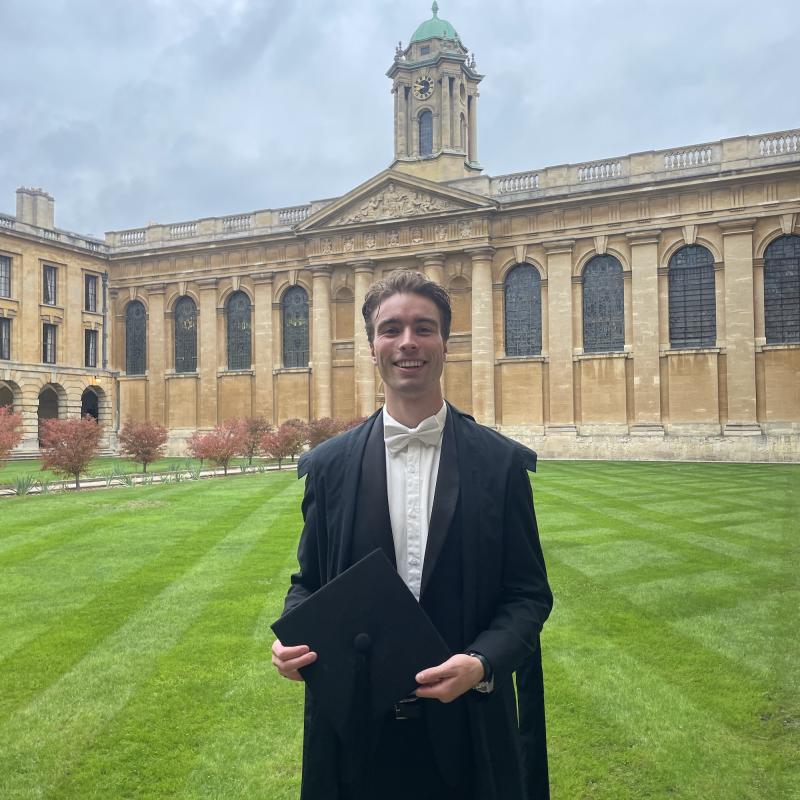
Billy Blackett (MPP 25), founder of two education enterprises in Tasmania and Rhodes Scholar, describes how a team of dedicated Master of Public Policy students shared their expertise on policy development, negotiation and collaboration with pupils from local schools in Oxford.
What does it take to design a new set of global goals from scratch, in a single morning?
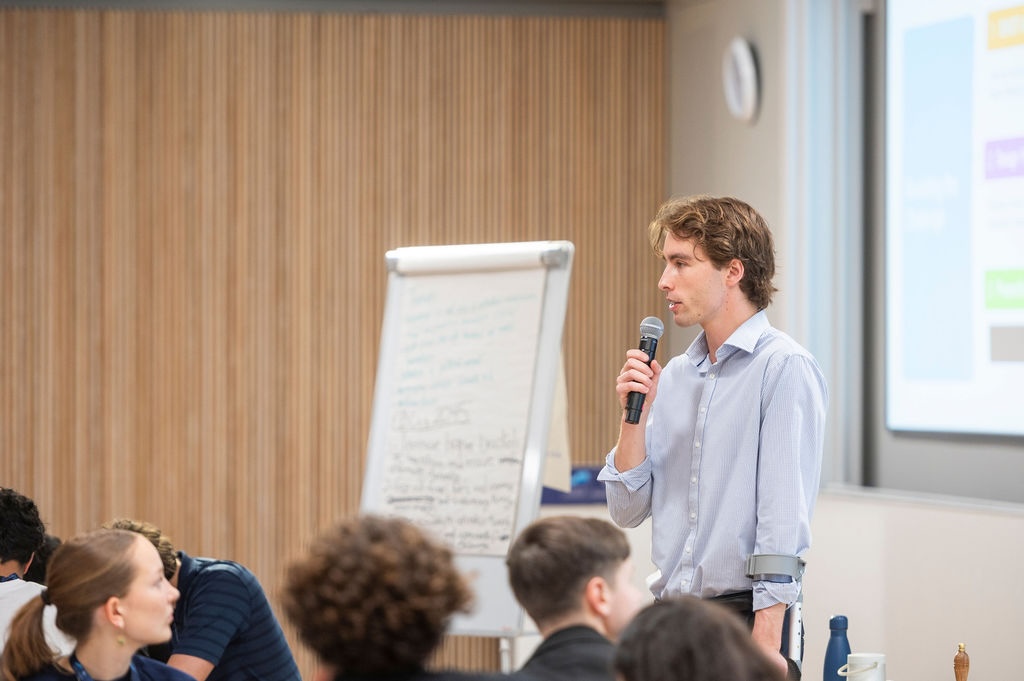
Thirty-eight Year 12 students from schools around Oxford came to the Blavatnik School for the inaugural Future Development Goals Challenge to find out.
Tasked with designing and launching a brand newbrand-new programme from the ground up, a small team of Master of Public Policy students, assembled for their experience, enthusiasm and appetite for a challenge, set to work months earlier with a simple checklist. They wanted to make it interactive and competitive, reflect the international character of the MPP and, above all, give the Year 12 students a genuine taste of what policymaking actually feels like.
The initiative was born out of student leadership. Our student secretary Aathma (India) had entrusted the task to myselfme, Alex Kelati and Alexander Jones from the UK and Atsuya Ito from Japan.
At first, there was one small complication: as both Alex Kelati and I will freely admit, we love to talk. And as any good facilitator knows, the more the hosts are speaking, the less learning is happening in the room.
That tension, it turned out, shaped the entire design of the day.
We began with a brainstorm. Thanks to the creative energy of Alex Jones, a long list of ideas took shape. Some fell short of our goals; others ticked every box but lacked the spark we were looking for. Eventually, we collectively landed on something exciting: tasking students with designing a new set of Sustainable Development Goals entirely from scratch, representing fictional nations, negotiating across borders and building coalitions to get their ideas adopted.
Then came the doubts. Would it be too dense? Too ambitious? Could a group of Year 12 students really determine the future of the world in a matter of hours? It was Atsuya, alongside the wonderful BSG programmes team, who helped to bring us back to earth, and to a unanimous agreement that it could be done, but only with the right people in the room.
The roles divided naturally from there. I recruited table leaders and volunteers and developed the slide deck. Alex Kelati built the six fictional nations and allocated volunteers to represent them. Alex Jones sourced the most trusted MPP students as judges and helped with logistics. Atsuya served as on-the-day manager, liaising with the programmes team to ensure everything ran smoothly, from materials laid out at each table to certificates, last-minute slide updates and much more.
With the team in place, the structure came together. Students were divided into cross-school teams, each representing one of six fictional nations. Following an opening welcome from Dean Ngaire Woods and an introduction to the existing SDGs delivered by Colombian MPP student Jorge Murillo Ferrer, teams began a SWOT analysis of their assigned nation, assessing its strengths, weaknesses, opportunities and threats. From there, each team designed three Future Development Goals suited to their country's circumstances and priorities. In the afternoon, the real diplomacy began: a coalition-building "Table Roulette" round in which teams had to pitch their goals to other nations, listen to competing priorities, and revise their proposals in pursuit of support. The session concluded with a peer vote on adopted goals and a Judges' Prize for the most engaged team.
Almost 20 volunteers stepped forward, and the day simply could not have happened without them. A special mention goes to Jorge Murillo Ferrer, whose overview of the existing SDGs set the tone beautifully. The full volunteer team brought energy, warmth, and genuine expertise to their tables throughout the day.
The students rose to the occasion. Their Future Development Goals ranged across issues of green technology sharing, measures to increase social cohesion, improved access to technical education, stronger indigenous knowledge transfer, equitable tax redistribution, infrastructure and much, much more. Across six fictional nations and a single morning, 38 young people produced a set of visionary goals, some of which will no doubt feature in future discussions at the highest level of politics.
What stood out most, however, was not what was on the slides. It was captured best in a message received from one of the attending teachers afterward:
"The teachers I spoke to from other schools, and our students, were unanimous in their praise for the MPP students, and how well organised the event was. But the main comment I heard was about how nice they were. We are so grateful for how much of their time they were willing to give up, and how free they were with their advice and offers of mentorship and support. You are lucky to work with such a great group of people."
On behalf of Atsuya, Alex Jones and Alex Kelati, I want to extend our deepest thanks to the MPP volunteers, the BSG programmes team, Dean Ngaire Woods, the teachers, and everyone else who gave their time to make the day possible. And most importantly, congratulations to the students, who were outstanding from start to finish.
The Future Development Goals Challenge is just getting started. I cannot wait to see where it goes.