From crises to reflection: what a year of thinking taught me about leadership
Elsie Addo Awadzi, the inaugural Women in Public Leadership Fellow and former Deputy Governor at the Bank of Ghana, underscores the importance of effective talent pipelines, intergenerational learning and reflection as a leadership tool.
What happens when you stop long enough to think?
For most of my career, that question was largely theoretical. Over thirty years of professional life in law, banking, consulting, capital markets regulation, graduate studies, international economics, policy making, and motherhood, stopping was rarely an option. And when I returned home to Ghana in February 2018 to serve as Deputy Governor of the central bank, it became even less so.
The seven years that followed could only have been scripted as a crisis simulation exercise. A banking sector clean-up of historic scale, a global pandemic, a war in Ukraine driving commodity price shocks, and a macroeconomic and sovereign debt crisis requiring comprehensive restructuring and other painful reforms. That, I have come to understand, is much of what public sector leadership now demands, particularly in countries that carry pre-existing vulnerabilities and absorb global shocks with limited buffers. Leaders have no choice but to lead through it, one crisis after another.
When my term ended in February 2025, I did something I had never quite done before: I gave myself permission to rest and reflect. Coming to Oxford as the inaugural Women in Public Leadership Fellow at the Blavatnik School was a deliberate choice, and a privilege for which I will be forever grateful.
The value of stopping
I did not come to Oxford simply to rest, though rest has been part of it. I came to think, to read, to listen, and to have the intellectual space that the urgency of public office rarely permits.
One of the most honest things I can say about this year is that it has involved as much unlearning as learning. When you spend years making decisions at pace, you develop habits of mind, ways of framing problems, instincts about what matters, that become almost automatic. Stepping back allowed me to examine some of those habits. To ask: which of them served the public good? And which were simply the armour that high-pressure leadership requires?
Three convictions have emerged from that examination.
Reflection is leadership work
The first is that reflection is not a pause from the work of leadership. It is a form of it.
The past year was generative in ways I did not fully anticipate. The distance gave me space to co-author a case study on Ghana's 2022 macroeconomic crisis and its decision to seek IMF support, a decision I lived through from the inside. It allowed me to share my experiences with students and faculty, to synthesise and publish the lessons from seven years of public leadership, and to write and share ideas through blogs and academic pieces that I simply could not have produced while inside the work.
But it was not only intellectual. Long walks along the canal and through the meadows, the charm of Oxford's old architecture, and the simple, underrated act of sitting with ideas rather than acting on them - all of it mattered. We invest heavily in preparing leaders to act.
We invest far less in creating the conditions for them to pause, unlearn, and think deeply. That imbalance has a cost, and it is one our leadership systems can ill afford.
Conversation as a leadership discipline
The second conviction is about the transformative power of conversation, something leadership development consistently undervalues.
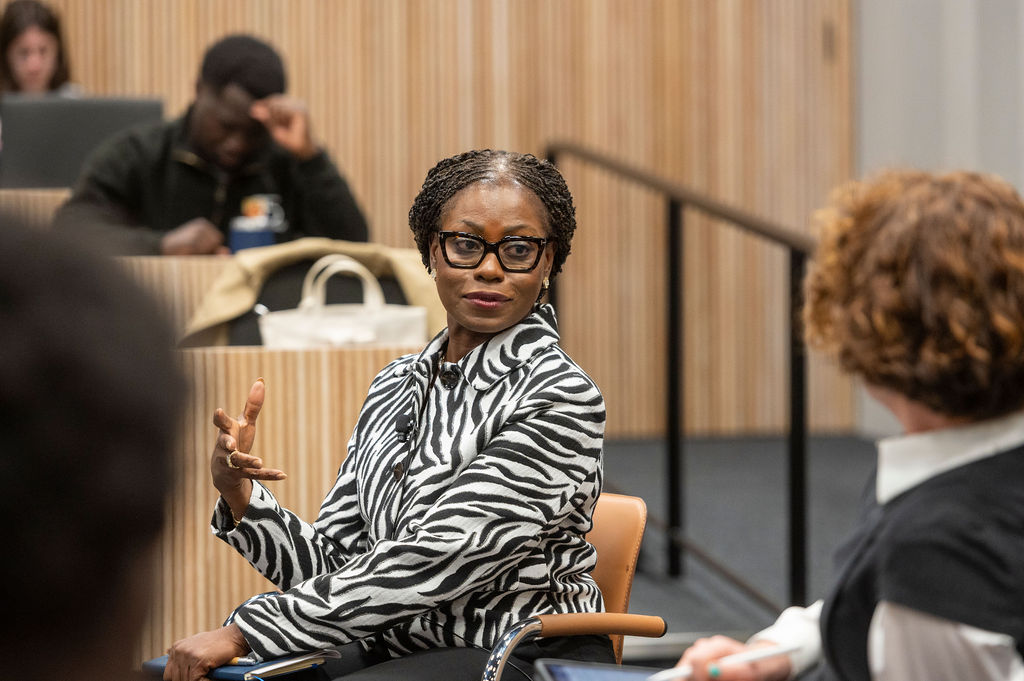
Informal exchanges in corridors and over lunch shifted mental models I had been stuck in for years. More formal ones, in classrooms, at Dean's Forums, listening to World Fellows, presidents, prime ministers, and practitioners from across the world, challenged long-held assumptions and validated my lived experiences in equal measure.
All of it reminded me that the work of governance is never finished, and that interdisciplinary and intergenerational dialogue is not incidental to that work. It is central to it.
Investing in the next generation
The third conviction is perhaps the most personal: investing in the next generation is not optional. It is an imperative.
The conversations I have had with the Master of Public Policy students this year, their questions, their energy, and their willingness to challenge received wisdom, have been among the most professionally renewing experiences of my career. They reminded me that leadership is not only about what you build while you hold office. It is equally about what you leave behind.
Three questions worth sitting with
These convictions have, in turn, sharpened three questions that I believe deserve serious attention from all of us who care about the future of public leadership.
The first is: how do we create more spaces and opportunities for leaders to reflect? We invest heavily in preparing leaders to act. We invest far less in creating conditions for them to pause, unlearn, and think deeply about the institutions they serve and the futures they hope to shape. Fellowships like this one are part of the answer, but they remain the exception, not the norm.
The second is: how do we build not just more leaders, but stronger leadership systems, systems that convert talent into authority, sustain institutions through political transitions, and prepare the next generation to lead in a world of growing complexity? What actually makes public institutions resilient, not just in a crisis, but across time and generations?
The third: how do we nurture genuine intergenerational learning? Not a one-way transmission of wisdom downward, but a two-way exchange, in which experienced leaders invest in emerging ones, and emerging leaders help experienced ones renew their thinking and challenge their assumptions. The conversations I had with students here this year showed me just how powerful that exchange can be, when the conditions for it exist.
Flying with two wings
This brings me to the work I have developed during this fellowship: the Women in Economic Governance Initiative (WEGI).
Key economic institutions, where decisions shaping the livelihoods of millions are made, remain overwhelmingly led by men across Africa and much of the world. The problem is not the pipeline. There is no shortage of highly qualified women. The problem is structural: opaque appointment processes, informal tests of "fit" and a “proof burden” applied more stringently to women, workplace cultures that penalise care responsibilities, and a persistent gap between representation and authority.
This is not a women's problem. It is a governance problem, and it affects everyone.
As I argued in a recent blog, institutions cannot fly with one wing. WEGI is designed to address this through three pillars: a Fellowship that accelerates the leadership journeys of accomplished women who have demonstrated technical excellence and leadership potential, but who would benefit from the last-mile developmental support, strategic exposure, and opportunities needed to assume greater leadership responsibility and influence; a Leaders' Circle that engages institutions in reforming succession systems and culture; and an evidence platform that tracks progress and shifts norms over time. I intend to pour myself into this work and into nurturing the next generation of women leaders in economic governance across Africa, while remaining open to advisory and academic opportunities.
More questions than answers
I arrived at the Blavatnik School with years of experience, considerable institutional memory, and, if I am honest, a measure of fatigue and a quiet uncertainty about what this year held.
What I am leaving with is harder to name. I feel a renewed sense of purpose, a clearer sense of what I believe about leadership and public service and a deep conviction about the value of spaces that bring together reflection, rigour, and dialogue across sectors and generations.
I came here to think. I wrap up the year with more questions than answers, and I mean that as the highest compliment I can offer this institution and this esteemed community.