

What a week in the ‘Tech and Justice Lab’ taught me about building a more just world
Paola Gutierrez Balderas, Master of Public Policy student, shares her insights from the MPP module the ‘Tech and Justice Lab’, led by Professor Philippa Webb and Visiting Professor Amal Clooney, co-founders of the Oxford Institute for Technology and Justice.

Public policy has always lived in the space between what should be and what is. We can have rights enshrined in constitutions and laws but without real guarantees to exercise them, they remain just that: words on paper.
The ‘Tech and Justice lab’, led by Professor Philippa Webb and Visiting Professor Amal Clooney, was precisely the module that made that tension productive, a space to explore how technology can become a real ally in closing the gap between the rights we proclaim and the justice people actually experience.
The lab brought together thirty students to engage with practitioners building real AI tools to advance justice. At its core, the course examined what responsible innovation looks like in practice.
This was not a class about ideas, but about practical courage, the kind that dares to imagine solutions and then does the hard, honest work of bringing them to life. Not with blind optimism, but with rigour, technical knowledge and responsibility.
Designing technology for people, not systems
Over five intensive sessions, we explored four projects tackling access to justice for women and girls, journalists and defendants in courtrooms. Each project had a different purpose, context and set of challenges. ‘Access to Justice for Journalists in the Age of AI’, developed by the Clooney Foundation for Justice, was built around a question that sits at the heart of press freedom: how do you protect those who risk their lives to tell the world what’s happening?
The Women Lawyers’ Association of Malawi showed us something equally powerful: a small group of lawyers with an enormous desire to help, using technology to bring free legal support to women and girls. It was a vivid example of the justice gap the module returned to repeatedly: the distance between having legal rights and being able to access them in practice.
The central lesson across the projects quickly became clear: behind every platform there are technical decisions to be made that, at their core, are ethical. The module challenged us to think beyond the technology itself and grapple with the questions that shape its impact. What kind of information do you actually need to make the platform work? How do you protect it without sacrificing efficiency? Are you seeking visibility because exposure protects, or anonymity because sometimes becoming invisible is what keeps people safe? There is no universal answer, but the obligation for policymakers was clear: to return to the purpose, to understand what is at stake for the people who will use the tool, and to design from there.
That design can only be honest if it is not just built for the people it serves, but with them. Co-designing is not consulting, it means sharing authority, listening deeply and paying attention to what datasets fail to capture: the informal rules and the invisible barriers. Because technology is not a parallel, aseptic world, it lands in real contexts, for real people, with problems that are never quite the same.
This becomes especially urgent when you cross borders. Think about a platform that gives legal information. In the UK, the challenge might be distinguishing the value of the platform from what large language models (LLMs) already offer – a problem of abundance. In Latin America, the question is different: the LLMs simply don't have reliable legal information about those systems. Or perhaps you only discover, by sitting with a community and truly listening, that what the law says and what people actually experience are worlds apart and that no dataset will ever tell you that. For policymakers, those differences matter because solutions that work in one context cannot simply be transplanted into another.
What the Tech and Justice Lab taught me as a policymaker
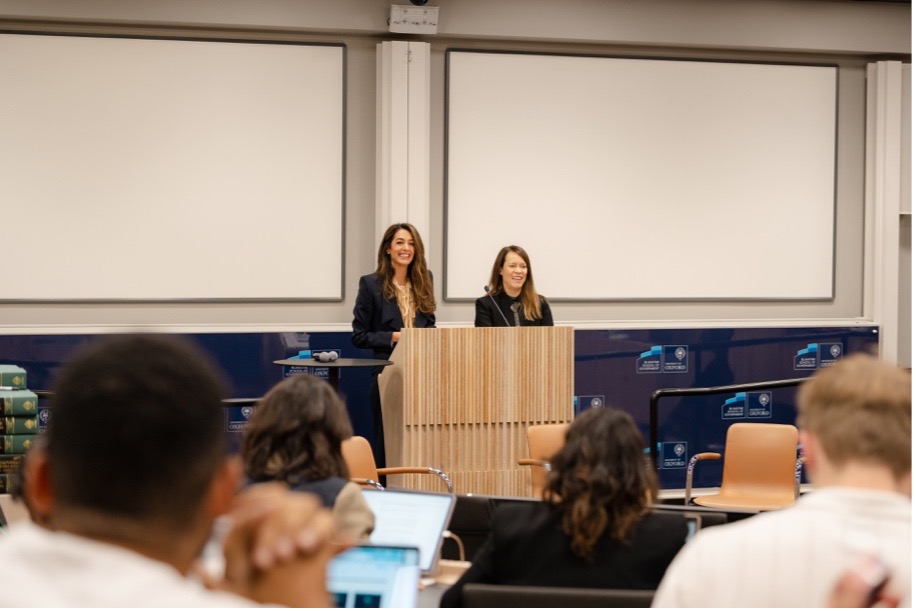
Visiting Professor Amal Clooney and Professor Philippa Webb built a classroom that was, above all, a dialogue. Classes weren’t just presentations but spaces to insist on the why and how behind every idea, to question, to push, to land. We heard from practitioners building these tools and were encouraged not just to listen, but to question assumptions and test ideas.
The module culminated with student teams designing an AI tool to protect a specific human right. The proposals revealed that behind every policy challenge was a personal story, a lived context, a real urgency. The environment that Amal and Philippa built from day one found its perfect ground in the diversity of the room: lawyers, activists, public officials, each with different histories and contexts, each filtering every project through their own reality.
At its core, this module was a reminder of why we are here as policymakers. Not just to have ideas but to learn to give them shape, structure and responsibility. To understand that change doesn’t arrive perfect or complete: it arrives in steps, with mistakes, with questions still unanswered, and that everything begins with daring with curiosity, an open mind, and enough humility to know there is always something we are not yet seeing. Technology is not the solution, but it can be a powerful tool for advancing justice when it is designed responsibly and with a clear understanding of the people it is intended to serve. This module challenged me to think more critically about the role policymakers play in making that possible.