

Finding nuance in the world’s most consequential relationship
Claire Fuchs, a 2025 Master of Public Policy student and Eisenhower Scholar, reflects on Professor Yeling Tan’s 'China and the World Economy' course, and how it deepened her understanding of China’s political and economic system while encouraging a more nuanced perspective on one of the world’s most consequential relationships.
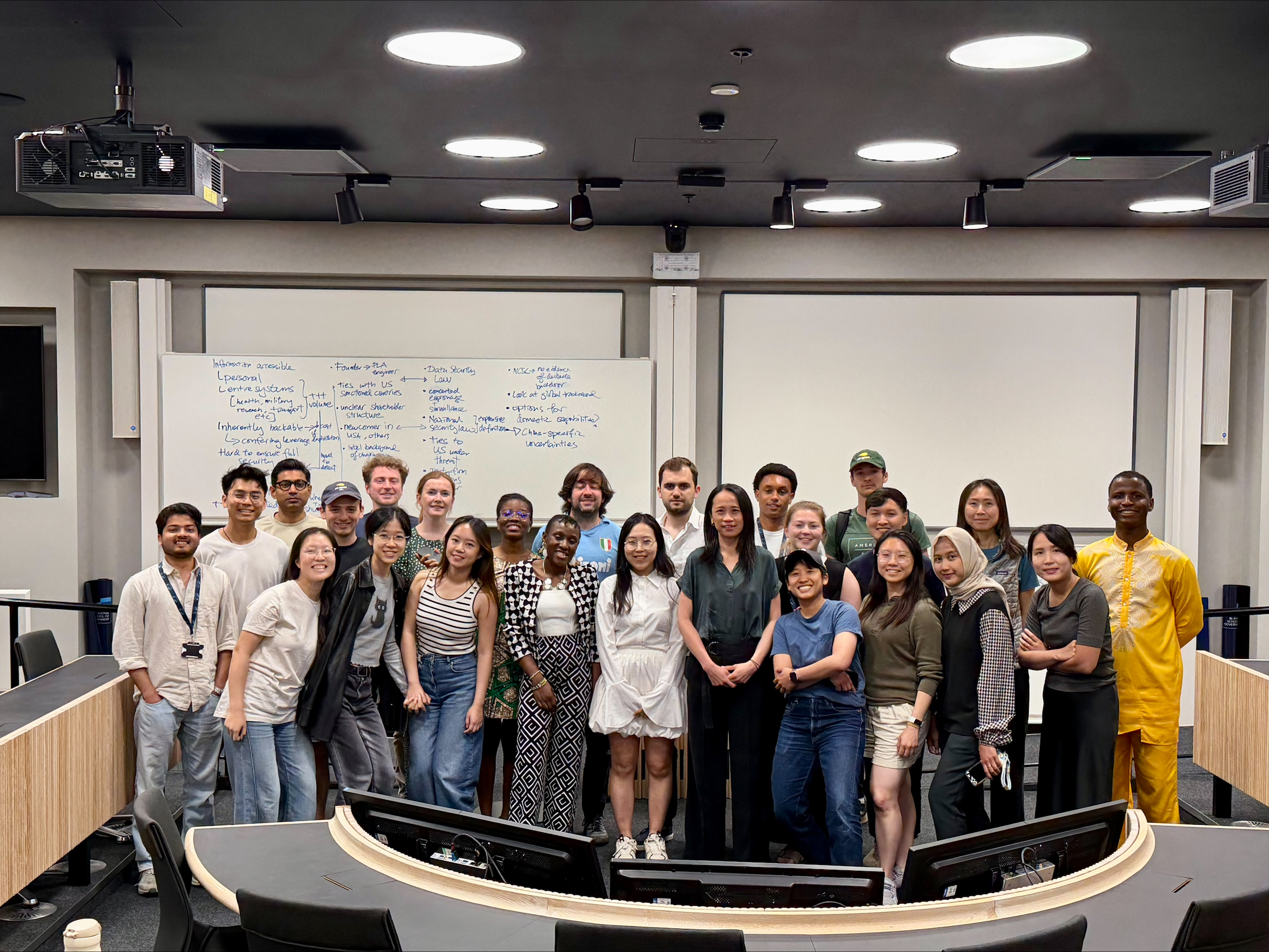
In a political moment where the only acceptable positions on China seem to be reflexive condemnation or uncritical celebration, genuinely nuanced analysis of China’s global strategy or domestic politics is rare, even within policy circles and serious journalism. Professor Yeling Tan’s course, 'China and the World Economy', did what every government needs its civil servants to do rapidly: develop an analytically rigorous understanding of China’s political system, economic development, party structure and outbound ambitions.
Before taking this module, my experience focused on analysing Chinese and Russian outbound investment and their geopolitical ramifications. As a geoeconomic influence and threat intelligence analyst, I developed a working understanding of foreign direct investment from Chinese state-owned enterprises (SOEs) and the risks and opportunities it creates, particularly through the Belt and Road Initiative – China’s global infrastructure and economic development strategy. But because my work has been so focused on outbound investment, I wanted a stronger understanding of the domestic tensions between SOEs, private companies, and the various levels of government within China.
Each week, around twenty students from six continents arrived to discuss and debate seven topics: China in a world of orders, domestic structures and fragmented authoritarianism, the World Trade Organisation, overseas investment and the Belt and Road Initiative, sovereign wealth funds and sovereign debt, green industrial policy, and economic security in the context of 5G infrastructure developed by Huawei.
The discussions were substantive and genuinely contested. Bringing in concepts from other courses, such as from the Politics of Policymaking, we interrogated how cleanly the boundaries of regime categories like democracy and authoritarianism applied to China. We unpacked the diverging institutional incentives of organs that might appear similar from the outside, like the Ministry of Commerce and the Ministry of Finance. We also examined how the Chinese Communist Party sustains itself through a carefully managed balance of adaptability and rigidity, including its carefully executed so-called corruption purges. Interestingly, our cohort expressed varying perspectives on the corruption purges, with some strongly supporting the initiative and others expressing potent distaste for their implementation, forcing us all to re-evaluate how we perceived the policies.
What made this more than just an exercise in content delivery were the case studies. The Hambantota port expansion project, undertaken by China Merchants Port Holdings in Sri Lanka, required us to map stakeholders and understand each actor’s motives, an exercise we did for every case study. What looked like a straightforward story of debt-trap diplomacy from the outside resisted any settled or straightforward conclusion upon closer examination. The case studies highlighted something essential: that many high-profile international developments are often far more complex than headlines suggest.
What became clear was how the ambitions, risk tolerance and political exposure of individual decision-makers can redirect projects worth billions, regardless of institutional design. This is something, at least from an analyst’s perspective, cannot always be thoroughly captured in data points.
Outside of the classroom, we attended lectures with visiting scholars and practitioners at the School. A conversation between Professor Tan and Georgetown’s Professor Ning Leng – whose recent book, Politicizing Business: How Firms Are Made to Serve the Party-State in China, has just been published – was particularly illuminating. Leng offered a sweeping account of how the Chinese Communist Party solicits political services from companies, generating economic instability and unintended development outcomes in the process.
What stayed with me was Leng’s attention to the human decision-making behind these dynamics: the psychology that shapes how individuals operating within these systems behave, especially on visibility projects. I was also shocked by the extent to which Beijing is aware of this psychology and the political services it provides, much less the economic ramifications of such scenarios.
Professor Tan’s course did not offer briefing-ready positions or algorithmic responses to the contingencies the West faces with China. The course instead encouraged us to see China’s politics beyond the monolith it is often portrayed as. It challenged us to hold in tension the genuine ambiguities that thoughtful analysis requires: cooperation versus coercion, economic interdependence versus decoupling, public goods versus competitive advantage, and blunt force versus leverage.
The duty now is to keep learning, and to share that knowledge with governments and citizens alike, so that we may better understand the political machine behind the world’s most rapidly modernising military and second largest economy.