

China as a “near-peer”: what the US 2025 National Security Strategy really signals
Master of Public Policy student Yuebing Gu, a former international journalist of Southern Weekly, examines the US’s 2025 Security Strategy and what this means for the future of US-China competition, Taiwan and the American alliances in the Indo-Pacific.
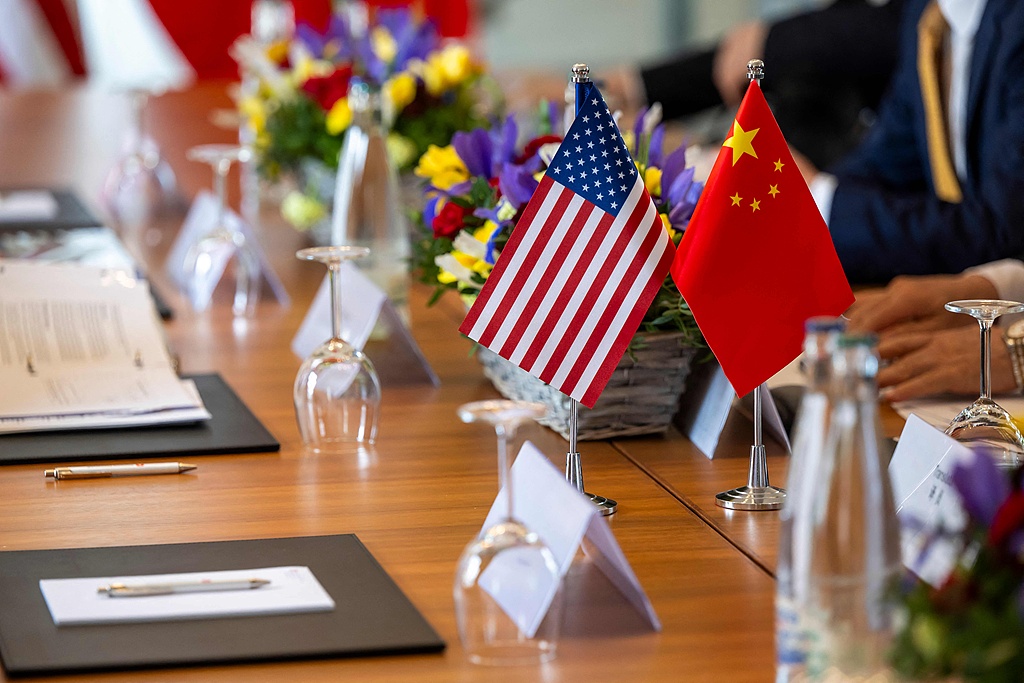
Reading the 2017, 2022 and 2025 US National Security Strategies(NSS) back-to-back reveals less about sudden swings in Washington’s attitudes towards Beijing than about a gradual reshaping of the rivalry itself.
The earlier documents framed China as a system-level challenger. The 2017 NSS called China and Russia “the revisionist powers”, casting the competition as a fundamentally political contest between repressive systems and societies. The 2022 NSS sharpened this diagnosis, warning that the People’s Republic of China “harbours the intention and, increasingly, the capacity to reshape the international order”, and identifying China as the only competitor with both intent and growing power to do so.
By contrast, the 2025 NSS, is explicit about prioritisation and consolidation. It says the US “cannot afford to be equally attentive to every region and every problem in the world”, elevates the Western Hemisphere through a “Trump Corollary” to the Monroe Doctrine, and then turns to Asia with a single organising headline: “Win the Economic Future, prevent military confrontation”.
This signals a shift in how the competition is framed. Rather than an ideological crusade or a clean break with China, the strategy points towards a controlled contest, tightened around arenas the document treats as measurable and leverageable: trade, technology, supply chains and industrial capacity.
China’s reclassification as a “near-peer” competitor
The most revealing admission in 2025 strategy is stated plainly: what began as an unequal economic relationship “has transformed into one between near-peers”. This is less a compliment than a strategic recognition. China is no longer framed primarily as a system-level ideological challenger, but as a competitor with comparable economic weight and technological capacity.
Economics is framed as “the ultimate stakes”. The stated objective is to “rebalance America’s economic relationship with China, prioritising reciprocity and fairness”, while keeping trade “balanced and focused on non-sensitive factors”. The document even holds out the possibility, carefully worded, of “a genuinely mutually advantageous economic relationship with Beijing”.
The strategy devotes substantial attention to semiconductors, artificial intelligence, advanced computing, algorithms, strategic minerals, and supply-chain security, portraying China’s progress in these areas as a decisive challenge to US national power. Washington’s objective is not merely to preserve its technological lead, but to prevent China from achieving technological self-sufficiency.
The centre of gravity of US national security strategy is clearly shifting away from a model built around global military deterrence and the projection of values, towards one that prioritises industrial sovereignty, supply-chain resilience, and control over critical production networks.
The erosion of explicit One China policy
Taiwan’s role shifts significantly across administrations. In 2017, Taiwan sits inside a familiar formula: the US would “maintain our strong ties with Taiwan” under its One China Policy, anchored in the Taiwan Relations Act
(TRA) and aimed at deterring coercion.
By 2022, the Taiwan Strait had become a test case for regional and global stability. The Biden administration’s strategy declared an “abiding interest” in peace, opposed “unilateral changes to the status quo from either side”, and adds the lawyerly red lines “we do not support Taiwan independence”, while reaffirming its One China policy.
The 2025 strategy retains the references to preserving the “status quo”, but strips away much of the surrounding scaffolding. It does not explicitly restate the One China Policy. The Taiwan section reads less like diplomacy and more like force-planning. Taiwan is described as strategically significant not only because of semiconductors, but because of its location along key sea lanes and its role in dividing Northeast and Southeast Asia into two theatres.
Deterrence is framed bluntly. Preventing a conflict over Taiwan, ideally by preserving “military overmatch”, is a priority, paired with a narrowed declaratory line that the US “does not support any unilateral change to the status quo in the Taiwan Strait”.
Strategic ambiguity, meanwhile, remains the performance art of choice. Trump has repeatedly declined to say whether the US would defend Taiwan if China used force, “I never comment on that”, he told reporters in 2025.
What’s new is the framing: Taiwan increasingly described as supply chains plus sea lanes plus military geometry, making the US silence feel louder and the region’s nerves easier to trigger.
Alliance: shared values to burden-shifting
The 2025 strategy does not discard alliances, but it alters their underlying logic. In the Indo-Pacific, allies are expected to spend more, contribute more operationally and provide greater access for US forces along the First Island Chain.
While allies are mentioned frequently, they are no longer portrayed primarily as partners in sustaining a liberal order, but as actors expected to shoulder greater responsibilities and costs. The emphasis is not merely on burden-sharing but on burden-shifting.
This logic echoes remarks by Vice President J.D. Vance at the 2025 Munich Security Conference, where he warned that continued US defence support could not be taken for granted if European allies failed to meet their own defence obligation.
This shift is reshaping the regional security environment. Arrangements such as AUKUS between Australia, the UK the US, while strengthening deterrence for some allies, have also heightened pressures for a regional arms buildup. Neighboring states, facing a more polarised security architecture, are increasingly compelled to pursue military modernisation of their own, reinforcing perception of an emerging arms race and contributing to a more volatile geopolitical climate.
Most consequentially, many Indo-pacific countries face a deepening security economics dilemma. On the one hand, many of those same allies are still reeling from Trump’s tariffs; on the other hand, their security depends heavily on the US, while their economic prosperity remains closely tied to China. As Washington pushes for tighter alignment and greater burden-sharing, these states are forced to balance alliance commitments against economic stability and regional peace.
As its core, the 2025 strategy reflects Washington’s attempt to recalibrate its traditional hegemonic approach, anchoring global engagement more tightly to what it defines as “core national interest”. Yet, a strategy shaped so strongly by unilateralism and exclusion risks weakening the foundations of multilateral cooperation, deepening mistrust among major powers, and adding new sources of instability to an already fragile international system.
Recent US actions and debates offer telling context. The capture of Venezuela’s president Nicolás Maduro, renewed talk of purchasing Greenland, and a broader turn toward isolationist rhetoric under the banner of “America First” point to the emergence of a new form of US hegemony.
The 2025 strategy sets out a world reordered through lines drawn by US interests. If sustained, such a course risks prolonging fragmentation, reinforcing hierarchy and limiting cooperation.